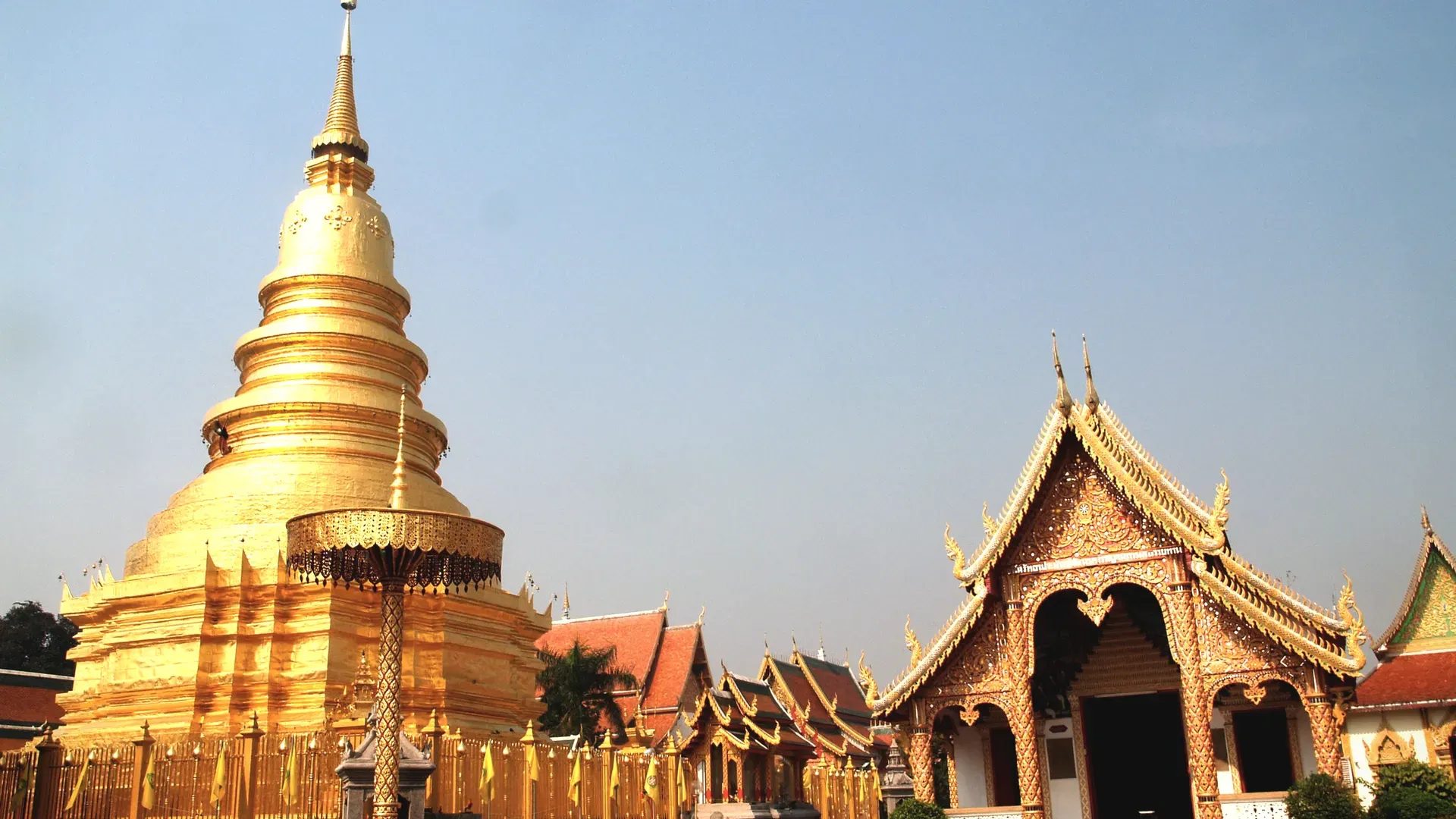
Lamphun is a small upper-northern province beside Chiang Mai, known for Wat Phra That Haripunchai, the old Hariphunchai kingdom, longan and a large industrial economy. Facts here come from Thai government sources.
NorthRegion
Mueang LamphunProvincial capital
ลำพูนThai name
Registered population
Lamphun had 393,508 people in the civil registration system in August 2026 (390,354 Thai nationals and 3,154 registered non-Thai nationals), according to the Department of Provincial Administration. That is the 64th largest registered population of Thailand's 77 provinces and about 0.6 percent of the national registered total of 65,677,170.
This is the number of people entered in the house registration system for the province, not a count of everyone who lives there. People who work in another province often stay registered at home, and most foreigners on short stays are not in the registry at all. Official table for August 2026 (read by BAANLYY on 14 November 2026) · Compare all 77 provinces
About Lamphun
Lamphun is the small province wedged between Chiang Mai to the north and west, Lampang to the east and south, and a corner of Tak. The National Statistical Office's 2023 provincial report puts it 689 kilometres from Bangkok by road, with a width of about 43 kilometres and a length of about 136 kilometres from north to south. The provincial town is about 26 to 33 kilometres from Chiang Mai along Highways 106 and 11, so for many people it works as a quieter neighbour of the northern capital.
It is one of the oldest settled places in the north. The provincial briefing and the NSO report both trace the town to Hariphunchai, a Mon-influenced kingdom that chronicles say was founded by a hermit and ruled first by Queen Chamadevi, and both say it fell to King Mangrai, who folded it into Lanna. Wat Phra That Haripunchai, the town's main temple, is the reason most visitors stop.
The economy is a surprise for a province with so little tourism. The NSO report records a gross provincial product of 88,614 million baht in 2021, the highest in the northern region and 14th in Thailand, with industry producing 55.8 percent of it. If you are weighing a move, think of Lamphun as a small provincial town with farms, factories and a strong temple culture, not a resort. BAANLYY has no local listings, partnered landlords or property managers here yet, so this page is a reference guide and not a property search.
Lamphun at a glance
Region
Upper northern Thailand, bordering Chiang Mai, Lampang and Tak source
Area
4,500 square kilometres (2,815,675 rai) in the NSO 2023 provincial report; 4,505.882 square kilometres in the provincial government's briefing document. Official sources differ slightly. source
Registered population
399,557 people in 2022 (191,596 men and 207,961 women) per the NSO; 398,532 in 2023 (190,927 men and 207,605 women) in the provincial briefing. Density about 88.6 people per square kilometre. source
Administrative divisions
8 districts, 51 subdistricts and 577 villages (2022) source
Distance from Bangkok
689 kilometres by road; about 724 kilometres by rail in one passage of the NSO report and about 729 in another source
Gross provincial product
88,614 million baht in 2021, or 226,464 baht per person: first in the northern region and 14th nationally (NESDC figures quoted by NSO). Industry made up 49,479 million baht, or 55.8 percent. source
Weather in 2022
131 rainy days and about 1,433 millimetres of rain source
Hospitals
14 hospitals in fiscal year 2022 (8 government, 5 private, 1 municipal), plus 81 subdistrict health-promoting hospitals; 159 doctors, 52 dentists, 911 nurses and 1,123 beds source
Schools
229 schools from kindergarten to secondary level, 3,559 teachers and 53,745 pupils in the 2022 school year, plus 10 vocational colleges with 7,579 students source
Where Lamphun sits
The province has two kinds of ground. The briefing and the NSO report describe Mueang Lamphun, Ban Thi, Pa Sang and Wiang Nong Long as low, well-watered river plain, the black-soil country around the Ping and Kuang rivers. Mae Tha, Thung Hua Chang, Li and Ban Hong are steep, mostly limestone mountains. Seven rivers matter for farming, including the Ping, Kuang, Tha, Li and Ko.
By area, Li is by far the largest district at 1,701.99 square kilometres, 37.96 percent of the province according to the provincial briefing, while Mueang Lamphun covers 479.825 square kilometres. Forest in the uplands is mostly dry mixed deciduous, and the NSO report says most of the province's forest is degraded. It also records coal deposits worked in Li and Thung Hua Chang.
Climate and the seasons
The NSO report describes three seasons: hot in March and April, rainy from May to October, and cool from November to February. Winter and summer together make a dry season of about six months. For 2022 it records 131 rainy days and about 1,433 millimetres of rain, which is a single-year reading and not a climate normal.
Check the seasonal smoke before you plan a long stay. The provincial briefing has a full chapter on the forest fire and haze situation in the province, which we did not read in detail, and northern Thailand has a recurring dry-season smoke problem. For temperature and rainfall normals use the Thai Meteorological Department, because we did not open its tables.
History and culture
Chronicle accounts give the town a long past. According to the Yonok chronicle as the NSO and Ministry of Commerce pages tell it, a hermit named Vasudeva gathered Mon people to build Hariphunchai between the Kuang and Ping rivers, then invited Chamadevi, a princess of Lavo, to rule. The NSO report puts the town's age at about 1,344 years and the provincial briefing says about 1,346, so the number depends on who is counting. Take the founding story as tradition, not as a recorded date.
The firmer evidence is archaeological and written. A skeleton found at Ban Wang Hai in 1987 is dated 2,800 to 3,000 years old, and the briefing says about ten Old Mon inscriptions have been found from the 15th to 17th centuries of the Buddhist Era. Chronicle accounts say King Mangrai took Hariphunchai in the reign of Phaya Yiba and made it part of Lanna, with the town staying a religious centre.
The town was emptied and refilled in the early Rattanakosin period. The Ministry of Commerce account says Phaya Kawila of Chiang Mai installed his brother as ruler of Lamphun and moved Yong people there, and the Yong weavers and craftspeople are credited with reviving local culture. The last ruling prince died after the 1932 revolution and Lamphun became an ordinary province under a governor.
How people earn a living here
Industry dominates the numbers. The NSO report says the sector produced 49,479 million baht of the 88,614 million baht provincial product in 2021, or 55.8 percent, followed by wholesale and retail trade including vehicle repair at 10,610 million baht (11.9 percent) and finance and insurance at 2,829 million baht (3.1 percent). Per person the province ranks first in the north.
Farming still matters for employment. The report lists shallots, garlic, Chinese kale, maize, cassava and soybeans, plus longan, mango, rubber and bananas. Longan appears in the province's own motto, and the Ministry of Commerce page gives the motto as praising the town's temple, its Phra Rod amulet, longan, garlic, traditions and Queen Chamadevi.
Getting to Lamphun
The NSO report lists Highway 11, the super-highway between Lampang and Chiang Mai, at about 33 kilometres to Chiang Mai and 70 kilometres to Lampang, and Highway 106 at about 26 kilometres to Chiang Mai. From Chiang Mai, Highway 1019 leads to Chiang Rai, about 210 kilometres. Inside the province, Highway 106 runs south from the town to Pa Sang, about 11 kilometres away, and on to Ban Hong and Li.
The northern railway line passes through with 68 kilometres of track and six stations: Pa Sao, Lamphun, Nong Lom, Sala Mae Tha, Tha Chomphu and Khun Tan. The report counts 6 freight and 16 passenger trains and says most passenger trains stop at Lamphun station; it does not give the year of that count, so check the State Railway of Thailand timetable. For flying, the report says to use Chiang Mai airport, about 30 minutes from Lamphun, with a flight of about 45 minutes from Bangkok.
Places worth knowing in Lamphun
Wat Phra That Haripunchai (วัดพระธาตุหริภุญชัยวรมหาวิหาร)
Temple
The main temple in the middle of Lamphun town. The NSO report gives the Lanka-style chedi as 46 metres high with a nine-tier golden umbrella and dates the temple to 1108 (BE 1651) in the reign of King Adityaraj. It opens from 06:00 to 18:00, and a bathing ceremony for the relic is held each year on the full moon of the sixth lunar month.
Important temple in Pa Sang district with a chedi on a hill behind the main buildings, blending Doi Suthep and Haripunchai styles. A flight of 469 naga steps links the hilltop chedi to the temple at its foot, and a road now reaches the top. A yearly ceremony bathes the Buddha footprint on the eighth waning day of the eighth lunar month.
Wat Phra Phutthabat Huai Tom (วัดพระพุทธบาทห้วยต้ม)
Temple and Karen community
Large temple in Li district with a Buddha footprint of about 1 by 2 metres in its mandapa and a golden Phra Borom That chedi, 34 metres high, built from April 1975 under Khru Ba Chaiwong. It is revered by the Karen community of Huai Tom, which the report says has about 1,200 families, and it has a gold chedi modelled on Shwedagon.
Doi Khun Tan National Park (อุทยานแห่งชาติดอยขุนตาล)
National park
National park that straddles the line between Mae Tha district in Lamphun and Hang Chat district in Lampang. The NSO report lists it among the province's natural attractions, and the provincial map in the same report marks it beside the railway station named Khun Tan. We did not find a Department of National Parks page to cite for its size or trails.
Ban Don Luang cotton weaving village (บ้านดอนหลวง)
Craft village
Weaving village in Pa Sang district known for hand-woven cotton. The provincial government upgraded its weaving centre, and the village hosts a cloth festival in early April each year, with traditional music and the large drum competition. Weaving is done under the houses, in the way the report describes.
Ban Tha Thung Luang wood-carving village (หมู่บ้านแกะสลักบ้านทาทุ่งหลวง)
Craft village
Largest wood-carving area in the province, in Mae Tha district, where villagers carve simple rain-tree figures such as flowers and fish, mostly for sale through shops in Chiang Mai. The report says carvers work daily from 08:00 to 17:00 and visitors can stop to watch and buy in the villages of the subdistrict.
The documented basics are strong for a province this size. In fiscal year 2022 Lamphun had 14 hospitals, eight of them government, five private and one municipal, plus 81 subdistrict health-promoting hospitals, 187 clinics, 159 doctors and 1,123 beds. The report's doctor-to-resident ratio is one for every 2,507 people. For schooling, the 2022 school year counted 229 schools with 53,745 pupils, ten vocational colleges and two higher-education institutions.
Utilities are listed too. Four provincial waterworks had a capacity of about 12.4 million cubic metres and produced about 5.7 million in 2022, and 205,626 electricity customers bought 2,060.40 million kilowatt-hours. What we could not find from an official source is a cost-of-living figure, typical rents, internet speeds or the size of the foreign community. If you are thinking of living here, visit in more than one season, read the smoke chapter in the provincial briefing, and talk to people who already do.
Renting, buying and visas
BAANLYY does not run a rental hub or local listings for Lamphun, so this page is a reference guide and not a property search. Thai law limits what foreigners can own, and the rules for condominiums, leaseholds and company structures differ from one another. Read BAANLYY's ownership guides and take advice from a qualified Thai lawyer before you commit money.
Your visa route matters more than the province you choose. BAANLYY's visa guides cover the long-stay options in plain language and cite the official Thai sources for each. Nothing on this page is legal, tax or immigration advice, and BAANLYY is a property portal and is not a party to independent owners', agents' or agencies' leases or sales.
What we could not confirm
We left these out rather than guess. If you hold a current official source for any of them, tell us at hello@baanlyy.com.
The town's age. The NSO report says about 1,344 years, the briefing about 1,346 and the Ministry of Commerce page about 1,343, so we give the range and treat the founding story as tradition.
The extent and figures of dry-season smoke and haze. The provincial briefing has a chapter on it that we did not read in detail.
Current train timetables. The report counts 6 freight and 16 passenger trains but does not date the count.
Official 30-year climate normals from the Thai Meteorological Department. The figure here is a single 2022 reading.
Cost of living, typical rents and house prices. We found no official source.
The size and make-up of the foreign community in Lamphun.
The size and trails of Doi Khun Tan National Park. The report names the park but the page we read cuts off before giving details, and we did not open a Department of National Parks page.
Visitor numbers and how much of the economy comes from tourism.
Map coordinates for the capital and the places listed. We did not find a government source that names each place and district, so no map is drawn on this page.
FAQ
Questions about Lamphun
How far is Lamphun from Bangkok?
The NSO 2023 provincial report gives 689 kilometres by road. By rail it gives about 724 kilometres in one place and about 729 in another, so the rail figure is approximate.
How far is Lamphun from Chiang Mai?
The NSO report lists about 26 kilometres along Highway 106 and about 33 kilometres on Highway 11. Chiang Mai airport is roughly 30 minutes from Lamphun.
How many people live in Lamphun?
The NSO reports 399,557 registered residents for 2022, and the provincial briefing gives 398,532 for 2023, about 88 people per square kilometre. The registered population section on this page gives the official registry figure for a later month.
What is Wat Phra That Haripunchai known for?
It is the main temple of Lamphun, with a 46-metre Lanka-style chedi. The NSO report says it opens from 06:00 to 18:00 and holds a relic-bathing ceremony on the full moon of the sixth lunar month.
What does Lamphun's economy depend on?
Mainly industry, which made up 55.8 percent of the province's 2021 output, ahead of trade. Farming, including longan, garlic and shallots, remains important for employment.
Does BAANLYY have rental listings in Lamphun?
No. BAANLYY has no local rental hub, listings or property managers in Lamphun yet, so use this page for orientation and check any property independently.
Is smoke a problem in Lamphun?
The province's own briefing contains a chapter on forest fires and haze, which signals that it is a recognised dry-season issue. We did not read its figures, so check current air-quality data before a long stay.
Facts on this page were checked against the sources above on 2026-10-12. Official figures change; confirm current numbers and rules with the relevant authority before relying on them.
BAANLYY LLC is a Nevada property portal. Homes are listed by independent owners, agents and agencies; BAANLYY is not a party to their leases or sales. Owners who contact BAANLYY directly can have their home listed and managed by the BAANLYY founding team under a written agreement. General information, not legal, tax, immigration or financial advice.