Thailand · Central · Nakhon Nayok
Nakhon Nayok (นครนายก)
Nakhon Nayok is a small eastern province about 105 km from Bangkok: 259,770 registered residents, waterfalls on the edge of Khao Yai, a big dam, and no BAANLYY listings yet.
Nakhon Nayok is a small eastern province about 105 km from Bangkok: 259,770 registered residents, waterfalls on the edge of Khao Yai, a big dam, and no BAANLYY listings yet.
Nakhon Nayok had 259,637 people in the civil registration system in August 2026 (258,304 Thai nationals and 1,333 registered non-Thai nationals), according to the Department of Provincial Administration. That is the 73rd largest registered population of Thailand's 77 provinces and about 0.4 percent of the national registered total of 65,677,170.
This is the number of people entered in the house registration system for the province, not a count of everyone who lives there. People who work in another province often stay registered at home, and most foreigners on short stays are not in the registry at all. Official table for August 2026 (read by BAANLYY on 14 November 2026) · Compare all 77 provinces
Nakhon Nayok is one of the smallest provinces in the eastern region, 2,122 square kilometres with four districts, and it sits about 105 km from Bangkok by the Rangsit to Nakhon Nayok road. The National Statistical Office (NSO) counted 259,770 registered residents at the end of 2024. That is a province of farms, waterfalls, army and police academies and weekend visitors, not a city.
If you are weighing a move, the thing to understand first is the pull of Bangkok. The province's own slogan, quoted in the NSO report, calls it a dreamy town close to the capital, with beautiful mountains and waterfalls. The northern and eastern edges are high ground that touches Khao Yai National Park, while the centre and south are flat, sandy farmland. You get green space and water within an hour or two of the capital, but you give up the choice of shops, hospitals and international schools that Bangkok has.
This page is built from official documents only: two editions of the NSO provincial statistical report, the provincial government's website and UNESCO. Where those sources are silent, the page says so under Not confirmed at the bottom. BAANLYY does not yet have local listings, partnered landlords or property managers in Nakhon Nayok, so nothing here should be read as a description of a rental market.
| Area | 2,122 square kilometres (about 1,326,250 rai), as given in the NSO 2025 provincial statistical report source |
|---|---|
| Registered population | 259,770 people at the end of 2024 (128,349 men and 131,421 women), from the NSO 2025 report, which draws on the registration record. Not the DOPA table itself; see Not confirmed. source |
| Administrative divisions | 4 districts (Mueang Nakhon Nayok, Ban Na, Pak Phli, Ongkharak), 41 subdistricts, 408 villages, 6 municipalities and 39 subdistrict administrative organisations source |
| Distance from Bangkok | About 105 km along the Rangsit to Nakhon Nayok road, or about 137 km along Highway 33 (Suwannason Road) source |
| Gross provincial product | 33,479 million baht at current prices in 2023, as reported by the NSO from the national planning agency (NESDC). Wholesale and retail trade is the leading sector, agriculture second. source |
| Highest point | About 1,292 metres, Khao Khiao, in the Khao Yai range on the province's northern edge source |
| Annual rainfall | About 3,008.5 mm in 2024 and 3,002.9 mm in 2023, per the NSO reports source |
| Public health facilities (fiscal year 2024) | 7 public hospitals, 56 sub-district health promoting hospitals and 86 clinics of all types; 88 physicians, 32 dentists and 527 nurses source |
| World Heritage link | Khao Yai National Park is part of the Dong Phayayen-Khao Yai Forest Complex, a UNESCO World Heritage property of 615,500 hectares source |
Nakhon Nayok borders Saraburi and Nakhon Ratchasima to the north, Prachin Buri to the east and south, Chachoengsao to the south, and Pathum Thani and Saraburi to the west, according to the NSO report. The northern and eastern parts are mountains in Ban Na, Pak Phli and Mueang Nakhon Nayok districts, partly inside Khao Yai National Park where three provinces meet.
The centre and south are low, sandy plains that suit farming, mostly in Pak Phli and Ongkharak districts. The Nakhon Nayok River rises in the Khiao and Khao Yai ranges, runs through the provincial capital to the south-west, crosses Ban Na and Ongkharak, and meets the Bang Pakong River in Ban Sang district of Prachin Buri. The NSO gives its length as about 130 km and calls it the river that makes the province's farmland fertile.
Forest covers about 396,467 rai, roughly 634 square kilometres, according to the same report. The notable natural resources it lists are soapstone (steatite), marble and rock crystal. UNESCO adds that the wider forest complex drains into five major Thai rivers, the Nakhon Nayok among them, which is why the province's waterfalls run so strongly in the wet months.
Rain is the defining feature. The NSO reports about 3,002.9 mm of rainfall in 2023 and about 3,008.5 mm in 2024, which is heavy even by Thai standards because the Khao Yai slopes catch the monsoon. The report itself describes the weather as neither extremely hot nor extremely cold.
Be careful with the temperature figures. The 2024 edition of the NSO report gives a highest temperature of about 38.2 and a lowest of about 15.5 degrees Celsius with 98 rain days for 2023, while the 2025 edition gives about 30.10 and 10.30 degrees with 172 rain days for 2024. The two editions use figures that do not line up, so this page does not treat either as a climate norm. Official Thai Meteorological Department normals for the province were not confirmed this run.
In practice the NSO's own tourism text tells you what to expect from the waterfalls: Sarika has plenty of water in the rainy season, Salat Dai has water mainly in the rainy season and early cool season, and Lan Rak runs only in the rainy season. If you plan a visit around the falls, the wet season is when they are at their fullest.
The NSO report says Nakhon Nayok is an old town, with excavations of the old town suggesting an age of at least 900 years and a possible link to the Dvaravati period. It records that under King U Thong the town was made a fourth-class town and an eastern frontier post against the Khmer. These are the report's statements of a tradition and an inference, not a dated founding.
The administrative story is easier to date. In B.E. 2437 (1894) the province became part of the Prachin Buri circle (monthon), alongside Prachin Buri, Phanom Sarakham and Chachoengsao. In B.E. 2445 (1902) the title of town ruler was abolished and a provincial governor appointed. The present provincial hall on Suwannason Road opened in February B.E. 2520 (1977), about 2 km from the town municipality office.
Local belief shapes the visiting calendar. The NSO report describes a replica Buddha footprint in a pavilion on Khao Nang Buat, reached by 227 concrete steps, built from B.E. 2401 (1858) and honoured with a fair in the middle of the fifth lunar month each year. It also describes the shrine of Chao Pho Khun Dan on Khao Cha-ngok, tied to a border-post commander said to have served under King Naresuan in B.E. 2130 (1587).
The Dong Lakhon ancient town, once called Mueang Lap Lae, is the main heritage site on record. The NSO describes earthen walls about 3 metres high with a moat on four sides and says the Fine Arts Department registered it as a national ancient monument on 8 March B.E. 2478 (1935). The Khmer-era origin and the legend of the lost town are the report's account; what remains is a rampart and moat line, not standing buildings.
According to the NSO, wholesale and retail trade is the leading sector of the provincial economy and agriculture is second, with most people still working in rice, orchards and field crops. Gross provincial product was 33,479 million baht at current prices in 2023, from the national planning agency's figures as quoted by the NSO. The 2024 edition of the report gave 32,511 million baht for 2022.
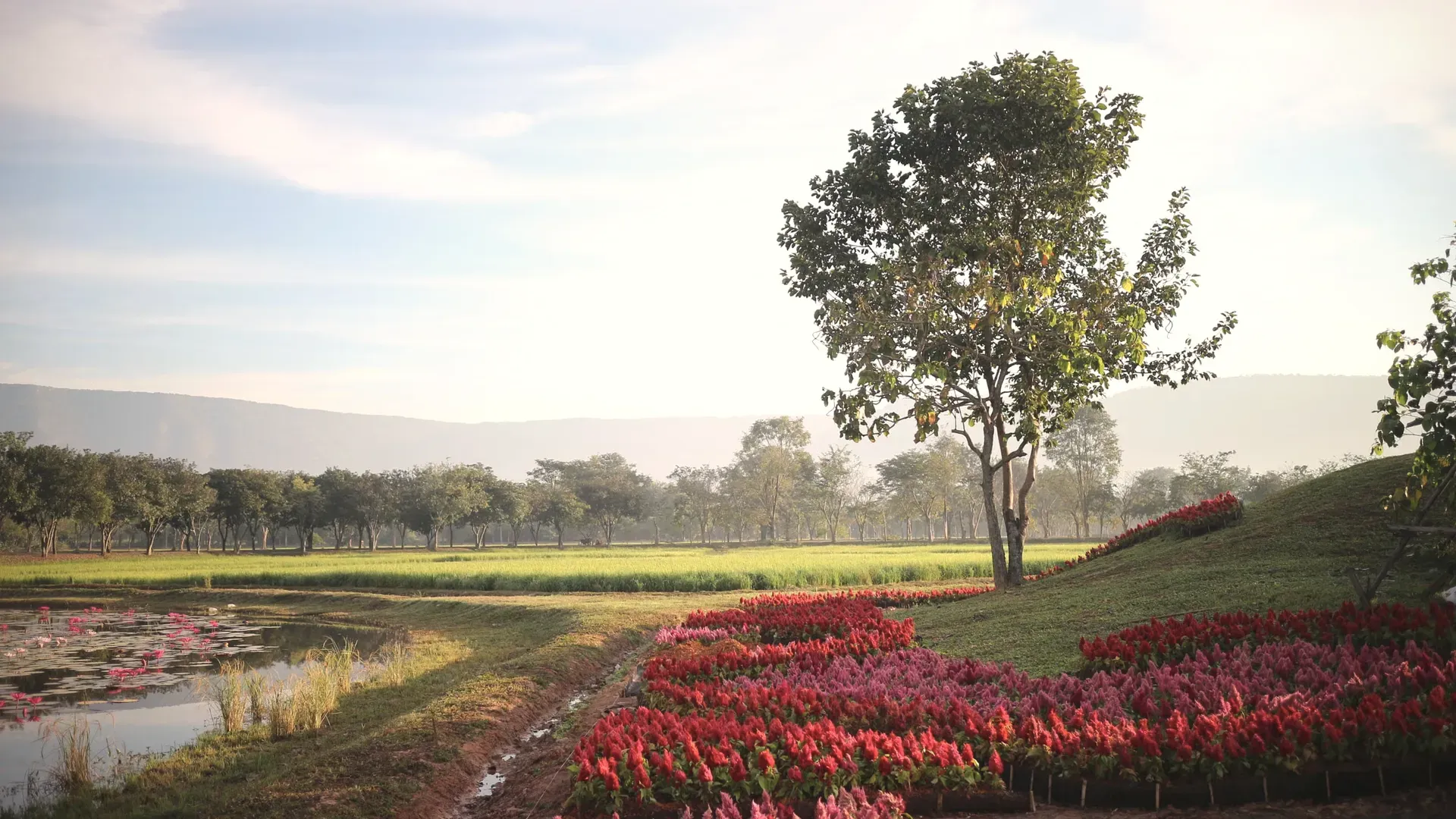
Flowers and ornamental plants are the best-known product. The NSO calls the Khlong 15 village in Ongkharak district the largest ornamental-plant centre in Thailand, with farmers growing and selling plants and shaped trees at low prices. The rest of the economy is farming, trade serving the tourist roads to the waterfalls and the dam, and the large military and police education campuses.
The per-head product figure in the NSO reports is 123,366 baht in both editions, which is unlikely to be right for two different years, so this page does not quote it. Local salary, unemployment and land-price data were not confirmed from an official page.
The NSO lists two national highways through the province: Highway 33, Suwannason Road, and Highway 305, the Rangsit to Ongkharak road. It puts the distance to Bangkok at about 105 km by the Rangsit to Nakhon Nayok route and about 137 km by Suwannason Road. Provincial, local and rural roads connect the districts in every season.
To reach Haew Narok from the capital, the report describes driving along Suwannason Road to the Noen Hom four-way junction at the Naresuan monument roundabout, then turning left onto Highway 3077 up toward Khao Yai to kilometre 24, followed by a 1 km walk. The Chulachomklao Royal Military Academy is about 14 km from the provincial capital and about 75 km from Bangkok along Highway 305.
Rail, scheduled bus and air connections were not confirmed from an official page, so this page does not describe them. Check current timetables with the bus operators or the State Railway of Thailand before planning a trip without a car.
Dam and visitor site
Built under a royal initiative at Ban Tha Dan, Hin Tang subdistrict, Mueang district. The NSO gives its length as 2,594 metres, height as 93 metres and capacity as 224 million cubic metres, and calls it the longest roller-compacted-concrete dam in the world. Visitors can walk the crest to see the town and Khao Yai. The provincial site's tourism list ranks it as its most viewed attraction page.
Waterfall
In Sarika subdistrict, Mueang district, about 15 km east of the provincial capital. The NSO describes nine tiers dropping from a cliff, each with a pool, and says the flow is strongest in the rainy season. The provincial government's tourism list includes it among its most viewed attractions.
Waterfall
In Hin Tang subdistrict, Mueang district, about 20 km east of the capital. The NSO calls it a medium-sized waterfall that steps down in low tiers, each with a small pool suitable for swimming. It is the second most viewed page on the provincial government's tourism list.
Waterfall in Khao Yai National Park
On the southern side of Khao Yai National Park. The NSO describes three tiers, the first about 60 metres, with a total drop of roughly 150 metres into a gorge, flowing hard in the rainy season. It sits at kilometre 24 of Highway 3077 followed by a 1 km walk. The park is part of the UNESCO-listed Dong Phayayen-Khao Yai Forest Complex.
Registered ancient monument
About 9 km south of the provincial capital in Dong Lakhon subdistrict. The NSO describes an earthen wall about 3 metres high, 350 metres wide and 550 metres long with a moat on all four sides, and says the Fine Arts Department registered it on 8 March B.E. 2478 (1935). The local name Lap Lae comes from a legend about a hidden Khmer town.
Plant nurseries and market area
Along both sides of the Khlong 15 road in Bang Plakot subdistrict, Ongkharak district. The NSO calls it the largest centre for flowers and ornamental plants in Thailand, where farmers propagate and sell plants and shaped trees at low prices. It is the clearest example of the farming economy that sits closest to Bangkok.
Military academy with visitor areas
At Phrommani subdistrict, Mueang district, about 14 km from the capital and 75 km from Bangkok along Highway 305. It trains army officers. The NSO notes that visitors can drive through parts of the campus, including a monument to King Chulalongkorn and a museum building, and the provincial site has a page for visiting it.
On health care, the NSO counts 7 public hospitals, 56 sub-district health promoting hospitals and 86 clinics of all types in fiscal year 2024, with 88 physicians, 32 dentists and 527 nurses. That is enough for routine care in a province of about 260,000 people. For complex treatment, the Bangkok hospitals are the realistic option, roughly two hours away by road in normal traffic.
On schooling, the NSO's 2024 academic year figures show 1,875 teachers and 34,675 pupils, a ratio of about 19 pupils per teacher. It was not confirmed whether any international or bilingual schools operate in the province, so a family with young children should ask the schools directly.
Foreign community, broadband speed, mobile coverage and everyday costs were not available from an official page, so this page does not describe them. Treat Nakhon Nayok as a place you should visit in different seasons and talk to residents before committing, rather than a market with published numbers.
BAANLYY does not have local listings, property managers or a tracked rental market in Nakhon Nayok. We cannot tell you typical rents or sale prices here. If you are considering a rental, the checks that matter are the usual ones: who the landlord is, what the written contract says, who pays utilities, and whether the building is outside the flood-prone low ground along the river.
On ownership, the Land Department's own guidance says foreign owners of condominium units in a single building must not exceed 49 percent of the total unit area of that building at the time of registration. This page is a summary of that one rule, not advice. Foreign ownership of land is a separate and more restricted matter, so speak to a Thai lawyer before buying anything.
Nothing about Thai visas changes from one province to the next. Which visa suits you depends on your nationality, age, income and plans, and the immigration office with jurisdiction over your address handles reports and extensions. Nothing on this page is legal, tax, immigration or financial advice, and BAANLYY LLC is a property portal, not a party to independent owners', agents' or agencies' leases or sales.
We left these out rather than guess. If you hold a current official source for any of them, tell us at hello@baanlyy.com.
The NSO gives about 105 km along the Rangsit to Nakhon Nayok road and about 137 km along Highway 33, Suwannason Road.
The NSO reports 259,770 registered residents at the end of 2024, with 128,349 men and 131,421 women. Registered residents are not the same as people who actually live there.
Waterfalls such as Sarika and Nang Rong, the Khun Dan Prakan Chon Dam, the edge of Khao Yai National Park and the Khlong 15 ornamental plant village in Ongkharak.
Part of it is. The NSO says about 24 percent of the park's forest lies in Nakhon Nayok, and the park spans four provinces, with Haew Narok waterfall on its southern side.
In the rainy season. The NSO says Sarika has the most water then, while Salat Dai and Lan Rak run mainly in the rainy season and the start of the cool season.
Not yet. BAANLYY has no confirmed local listings, landlords or property managers there, so this page does not quote rents or prices.
Under the Land Department's guidance, foreign owners combined may hold up to 49 percent of the total unit area of a condominium building. Ask a Thai lawyer about your specific case.
Facts on this page were checked against the sources above on 2026-10-12. Official figures change; confirm current numbers and rules with the relevant authority before relying on them.
BAANLYY LLC is a Nevada property portal. Homes are listed by independent owners, agents and agencies; BAANLYY is not a party to their leases or sales. Owners who contact BAANLYY directly can have their home listed and managed by the BAANLYY founding team under a written agreement. General information, not legal, tax, immigration or financial advice.