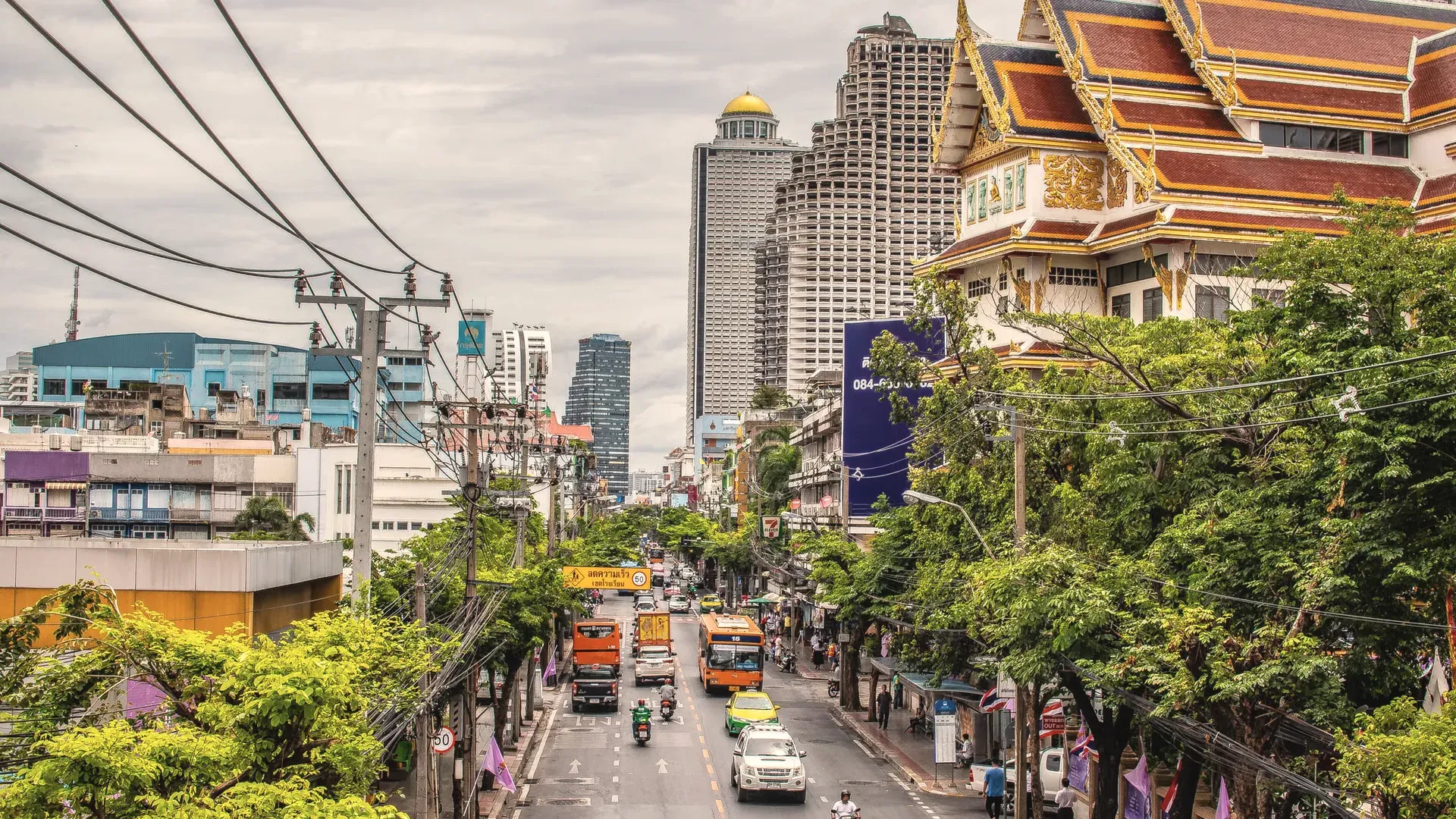
BMTA, the state Bangkok Mass Transit Authority, runs the main city bus network, and a ride costs 8 to 25 baht. A red and cream ordinary bus is 8 baht for the whole route; air-conditioned buses are 12 to 25 baht by distance, plus 2 baht on the expressway. You can pay the fare collector in cash, tap a contactless Visa or Mastercard on the collector's machine, or scan the bus's QR code in the BMTA Application. A daily rider can buy a monthly pass: 1,020 baht for air-conditioned buses or 480 baht for ordinary ones, valid 30 days from the first tap. Routes are being renumbered, so a bus may show an old number such as 26 and a new one such as 1-36. For the trains, see our BTS and MRT fares and cards guide.
Who runs Bangkok's city buses?
Two kinds of operator share the streets. BMTA's service rates page describes the Bangkok Mass Transit Authority as a state enterprise set up by royal decree in 1976 (B.E. 2519) to run scheduled buses in Bangkok, Nonthaburi, Nakhon Pathom, Pathum Thani, Samut Sakhon and Samut Prakan. It counts 117 routes and, as of April 2025, 1,519 ordinary buses and 1,365 air-conditioned buses of its own.
The same page lists the private joint-service operators that run under BMTA's network: 1,303 small soi buses, 900 air-conditioned vans and 33 natural gas vans linking Suvarnabhumi Airport. The private operator with its own fares and its own card is Thai Smile Bus; its own page describes an all-electric fleet on 123 routes across Bangkok and its neighboring provinces.
The difference matters for your wallet: BMTA's weekly and monthly passes do not work on private joint-service buses, and Thai Smile Bus has its own fares and card (section 06).
What does a Bangkok bus ride cost?
You can tell the fare from the bus's color. BMTA's service rates page, read 27 November 2026, prints this table:
| Bus type | Color | Fare | Service hours |
|---|---|---|---|
| Ordinary (no air-conditioning) | Cream and red | 8 baht for the whole route; 1.50 baht service charge on the late-night shift; 2 baht more on the expressway | 05:00 to 23:00 |
| Air-conditioned | Cream and blue | 12, 14, 16, 18 or 20 baht by distance; 2 baht more on the expressway | 05:00 to 23:00 |
| Air-conditioned (Euro) | Yellow and orange | 13, 15, 17, 19, 21, 23 or 25 baht by distance; 2 baht more on the expressway | 05:00 to 23:00 |
| Air-conditioned, natural gas (NGV 489) | Sky blue | 15, 20 or 25 baht by distance; 2 baht more on the expressway | 05:00 to 23:00 |
On an air-conditioned bus the fare goes up with distance, so tell the fare collector where you are getting off. The page gives the service hours of every type as 05:00 to 23:00, while its bus lines page shows some routes running around the clock (section 08).
Thai Smile Bus fares, from its FAQ: 15, 20 or 25 baht on its blue electric buses and 10 baht for the whole route on its orange buses without air-conditioning.
How can you pay: cash, card or app?
BMTA's notice on payment channels, dated 14 May 2026, lists three ways to pay on its buses:
- Cash, to the fare collector.
- The BMTA Application (App Store and Google Play): scan the QR code sticker on the bus, buy a single ticket in the app, or buy a weekly or monthly pass in the app.
- The EDC machine the fare collector carries, which takes the state welfare card (the smart national ID card), Visa and Mastercard debit and credit cards with the contactless symbol, a bank app scanning a QR code on the machine, and BMTA's electronic weekly and monthly cards.
A prepaid card that also works on the trains. Krungthai Bank's Mangmoom EMV page lists BMTA buses first among the places the card can be tapped, along with expressways, the MRT Purple, Blue, Yellow and Pink lines, the SRT Red Line and the Airport Rail Link. Issuing one in the Pao Tang app costs 50 baht plus 42 baht delivery; at an MRT Blue or Purple line station it costs 250 baht, of which 100 baht is value on the card. The page adds that the card must be linked to Pao Tang Pay before it works on buses, the Red Line, the Airport Rail Link and expressways, and that tap-to-pay opens on each channel on the date the bank sets.
In practice a resident needs nothing new: carry small notes and coins for the fare collector, or tap the same contactless Visa or Mastercard you use on the MRT.
What do BMTA weekly and monthly passes cost?
BMTA calls them advance electronic tickets. The prices on its page, read 27 November 2026:
| Card | Type | Price |
|---|---|---|
| Air-conditioned, general public | Monthly | 1,020 |
| Air-conditioned, general public | Weekly | 255 |
| Ordinary, general public | Monthly | 480 |
| Ordinary, general public | Weekly | 120 |
| Air-conditioned, students from M.4 (grade 10) and university | Monthly | 540 |
| Ordinary, students from M.4 (grade 10) and university | Monthly | 270 |
| Air-conditioned, students up to M.3 (grade 9) | Monthly | 270 |
| Ordinary, students up to M.3 (grade 9) | Monthly | 135 |
The rules, from the service rates page:
- Which buses. BMTA heads the card rules category 1 buses only, then says the cards give unlimited trips on every BMTA route within the dates on the card, except private joint-service buses.
- An ordinary-bus card does not work on air-conditioned buses; an air-conditioned card also works on ordinary buses.
- Expressway and all-night buses are included with no extra charge.
- Student cards need a school uniform or a student card.
When the dates start. BMTA's press release No. 037/2568 of 11 March 2025 says that since 8 March 2025 a monthly card runs 30 days and a weekly card 7 days, counted from the day you first tap it: a monthly card first tapped on 8 March 2025 ran to 6 April 2025. Before that, a monthly card ran from the first tap to the end of the same calendar month, and a weekly card ran in set weekly cycles.
BMTA's 14 May 2026 notice adds two more cards: a Co-Brand stored-value card loaded from 50 to 1,000 baht that deducts the normal cash fare, and a Transit Pass RED Line SRTET x BMTA at 2,000 baht a month for 50 trips on the SRT Red Line plus unlimited BMTA buses of every type, with a 100 baht issue fee.
Does a pass pay? This is our arithmetic on the printed prices. At a 20 baht air-conditioned fare, the 1,020 baht monthly card costs the same as 51 trips (51 x 20 = 1,020), so it saves money from the 52nd trip in 30 days. At the 8 baht ordinary fare, the 480 baht card equals 60 trips (60 x 8 = 480). Someone riding to work and back on 22 working days makes 44 trips, which at 20 baht is 880 baht, so the card is worth it only if you also ride at weekends, change buses or pay a higher fare per trip.
Why do Bangkok buses have two route numbers?
Bangkok routes now carry a new number alongside the old one. BMTA's bus lines page prints each route with its old number first and the new number in brackets. Examples from the page on 27 November 2026:
| Old number | New number | What the page shows |
|---|---|---|
| 26 | 1-36 | Min Buri to the bus terminal, 00.00 to 23.59 |
| 26E | 1-35E | Min Buri to Victory Monument, 00.00 to 23.59 |
| 145 | 3-18 | Soi Thetsaban Bang Pu 39 to the bus terminal, 24 hours |
| 505 | 2-24E | listed under air-conditioned (Euro) |
| 24 | 2-39 | listed under air-conditioned (Euro) |
Stops, bus windows and apps may use either number, so a route you know as 26 can appear as 1-36. The same page lets you search by origin, destination, route number or bus stop, and filter by bus type, by expressway or normal route and by BMTA operating zone, which is the quickest official way to check a route before you move.
Thai Smile Bus runs its own app, TSB Go Plus, which its service page says shows routes and journey times. BMTA questions go to its 1348 hotline or LINE account @bmta, as its notice lists.
How do Thai Smile Bus and the HOP card work?
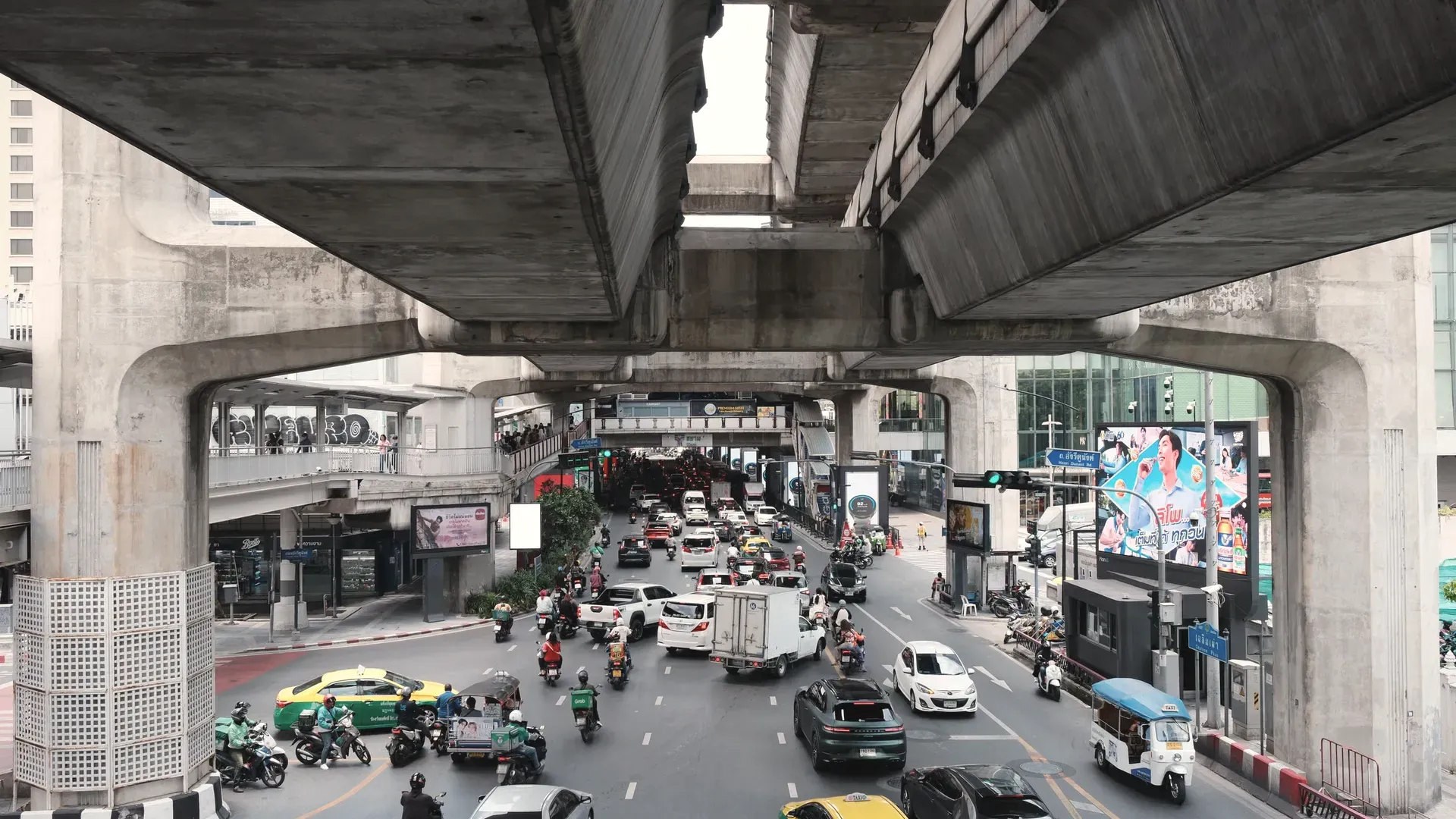
Thai Smile Bus runs blue electric buses with air-conditioning and orange buses without it. Its FAQ, read 27 November 2026, says:
- Fares: 15, 20 or 25 baht on the blue buses, 10 baht for the whole route on the orange ones.
- The HOP card pays fares on Thai Smile Group's electric buses and boats only. It is sold on the buses, at the bus depots and boat piers, and online through Shopee, Lazada and LINE.
- Daily Max Fare: with a HOP card you pay at most 40 baht a day on the buses, or 50 baht a day combining bus and boat.
- Tap twice. Tap the black E60 reader by the door when you board and again when you get off.
- Top up by scanning the QR code on the back of the card and paying from a linked Krungthai or SCB account or any bank's QR payment; then tap the card on the yellow AVM machine on board and hold it for 5 seconds to load the money. Each top-up needs its own tap on the AVM.
- Lost card: if you registered it in the TSB Go Plus app, buy a new card and call the call center to move the balance across.
- Board at the front, leave at the back.
Our arithmetic: at 20 baht a ride, two rides reach the 40 baht cap, so further Thai Smile bus rides that day cost nothing more on a HOP card.
Who rides free or at half fare?
Free on BMTA buses, per its service rates page: land transport inspectors, monks and novices, nuns with an ordination certificate from their practice center and a national ID card, uniformed postal workers on duty, BMTA staff card holders, and holders of a government card or medal that carries a free-travel right. Thai Smile Bus's FAQ lists monks, novices and nuns as riding free.
Half fare on BMTA ordinary buses, from the same page:
- Blind passengers with a certificate from the blind association.
- Soldiers and police in uniform.
- Holders of named government cards or medals, such as the Victory Medal and veterans' family cards.
- Older persons under the Elderly Persons Act 2003 (B.E. 2546) who show their national ID card, on BMTA buses and those of operators running jointly with BMTA.
- Disabled passengers of every kind, visibly disabled or holding a disability association membership card, on category 1 routes running on into neighboring provinces and category 4 routes in Bangkok.
The page also prints half fares including fees for air-conditioned buses: 8 baht for a 12 baht fare, 10 for 14, 11 for 16, 13 for 18 and 14 for 20; 9 for a 13 baht Euro fare up to 18 for 25; and 11, 14 and 18 baht for the 15, 20 and 25 baht natural gas fares.
Thai Smile Bus gives half fare to people aged 60 and over who show their national ID card, to disabled passengers and to holders of official cards that carry a half-fare right, citing a Department of Land Transport letter.
What this means for a foreign resident. Both senior rules ask for the national ID card. On our reading, a foreigner who holds only a passport should not count on the senior half fare; ask the fare collector. Our living in Thailand with a disability guide covers access on buses and trains.
Do buses run at night, and what does the expressway cost?
- Late-night service. The service rates page adds a 1.50 baht service charge to the 8 baht ordinary fare on the late-night shift. BMTA's bus lines page shows some routes running all night: route 145 (3-18) is listed as 24 hours, and routes 26 (1-36) and 26E (1-35E) as 00.00 to 23.59.
- Expressway. Every BMTA bus type adds 2 baht when it takes the expressway. Weekly and monthly cards cover expressway and all-night buses with no extra charge.
- Getting to the airports. For the airport bus routes and fares, see our Bangkok airport transfer guide.
What should a new resident know before the first ride?
- Know your stop in Thai or on a map. On air-conditioned buses the fare depends on where you get off.
- Carry small change, or a contactless Visa or Mastercard for BMTA buses.
- Check the color and the operator. A BMTA pass works only on BMTA buses; a HOP card only on Thai Smile buses and boats.
- Check both route numbers on BMTA's bus lines page before you rely on an old map.
- Pets stay home. Thai Smile Bus's FAQ says no pets of any kind on scheduled buses, citing the Central Land Transport Control Board's rules under the Land Transport Act.
- Lost something? Thai Smile Bus asks for the route, the bus number or plate, the time and a description or photo of the item, by its Facebook page or call center.
Choosing where to live near a good bus line can save more than any pass: our best Bangkok neighborhoods for expats guide and the getting around Bangkok guide compare the options, and Bangkok boats and ferries covers the river.
Frequently asked questions
On BMTA's service rates page read 27 November 2026, a red and cream ordinary bus costs 8 baht for the whole route, a cream and blue air-conditioned bus 12 to 20 baht by distance, a yellow and orange air-conditioned (Euro) bus 13 to 25 baht and a sky blue natural gas bus 15, 20 or 25 baht. Taking the expressway adds 2 baht. Thai Smile Bus, a private operator, charges 15, 20 or 25 baht on its blue electric buses and 10 baht flat on its orange buses without air-conditioning.
On BMTA buses, yes. BMTA's notice of 14 May 2026 lists Visa and Mastercard debit and credit cards with the contactless symbol among the ways to pay through the EDC machine the fare collector carries, alongside cash, the BMTA Application (scan the QR code sticker on the bus) and bank apps scanning a QR code on the EDC. Krungthai's Mangmoom EMV prepaid card also lists BMTA buses. Thai Smile Bus uses its own HOP card.
Yes, for BMTA's own buses. BMTA's advance tickets page lists 1,020 baht a month or 255 baht a week for air-conditioned buses and 480 baht a month or 120 baht a week for ordinary buses, and its payment notice adds a 30 baht card issue fee. Since 8 March 2025 a monthly card runs 30 days and a weekly card 7 days from the first tap. The cards do not work on private joint-service buses.
Bangkok routes now carry a new number alongside the old one, and BMTA's bus lines page prints both: the old number first and the new one in brackets, for example 26 (1-36), 26E (1-35E) and 145 (3-18). Signs, stops and apps may show either, so search by both when you plan a trip.
Do not count on it. BMTA gives half fare to older persons under the Elderly Persons Act 2003 who show their national ID card, and Thai Smile Bus to people aged 60 and over who show their national ID card. Both rules name the Thai national ID card; on our reading that leaves out a foreign resident who holds only a passport, so ask the fare collector before you pay.
The HOP card is Thai Smile Group's stored-value card for its electric buses and boats only. Its FAQ says a holder pays at most 40 baht a day on Thai Smile Bus, or 50 baht a day for bus and boat together. You tap the black reader by the door when you board and again when you get off, top up by scanning the QR code on the back of the card, then tap the yellow machine on board for 5 seconds to load the money.
Not on Thai Smile Bus: its FAQ says no pets of any kind are allowed on scheduled buses, citing the rules of the Central Land Transport Control Board under the Land Transport Act. Plan another way to move a pet.
Want a home on a good bus or train line?
Browse Bangkok condos and homes listed by partnered agents, then price the commute before you sign.
General information only. Fares, passes, discounts and payment methods are from BMTA's pages (service rates and advance tickets, undated; payment notice dated 14 May 2026; press release of 11 March 2025 on pass dates; bus lines), Thai Smile Group's service page and FAQ, and Krungthai Bank's Mangmoom EMV page, as they showed on 27 November 2026. BMTA's pages render only in a browser and were read from screenshots. Savings figures are our arithmetic. Operators change fares and routes without notice: check before you ride.
Sources
- BMTA, service rates page (Thai, undated, read 2026-11-27 from a screenshot): 117 routes; 1,519 ordinary and 1,365 air-conditioned buses (April 2568); joint-service 1,303 small soi buses, 900 air-conditioned vans, 33 CNG vans to Suvarnabhumi; ordinary cream-red 8 baht whole route, late-night shift +1.50 baht; air-conditioned cream-blue 12 14 16 18 20 baht; Euro yellow-orange 13 15 17 19 21 23 25 baht; NGV 489 sky blue 15 20 25 baht; expressway +2 baht; 05:00-23:00; free: inspectors, monks, novices, nuns with ordination certificate and ID card, postmen on duty, BMTA staff, official cards with free right; half fare on ordinary buses: blind association certificate, soldiers and police in uniform, official cards and medals, Elderly Persons Act 2546 with national ID card, all disabilities on category 1 and 4 routes; weekly and monthly cards (rules headed category 1 buses only) unlimited on all BMTA routes except joint-service, ordinary card not on air-conditioned, expressway and all-night included; half fares including fees 12/8 14/10 16/11 18/13 20/14, Euro 13/9 to 25/18, NGV 15/11 20/14 25/18 ↗Bangkok Mass Transit Authority · Accessed 27 November 2026
- BMTA, advance tickets page (Thai, undated, read 2026-11-27 from a screenshot): air-conditioned monthly 1,020 baht, weekly 255 baht; ordinary monthly 480 baht, weekly 120 baht; air-conditioned students M.4 up and university 540 baht, up to M.3 270 baht; ordinary students M.4 up and university 270 baht, up to M.3 135 baht; Co-Brand stored-value card from 50 baht ↗Bangkok Mass Transit Authority · Accessed 27 November 2026
- BMTA, news item on fare payment channels (Thai, 14/05/2569 = 14 May 2026, read 2026-11-27 from a screenshot): cash to the fare collector; BMTA Application to scan the QR code on the bus, buy single tickets and weekly or monthly cards; EDC machine for the state welfare card (smart ID card), contactless Visa and Mastercard debit and credit cards, bank app QR, electronic weekly and monthly cards; 30 baht card issue fee; Co-Brand card 50 to 1,000 baht; Transit Pass RED Line SRTET x BMTA 2,000 baht a month, 50 Red Line trips and unlimited BMTA buses, 100 baht issue fee; hotline 1348, LINE @bmta ↗Bangkok Mass Transit Authority · Accessed 27 November 2026
- BMTA, press release No. 037/2568 dated 11 March 2568 (11 March 2025, posted 12/03/2568; Thai, read 2026-11-27 in a browser): from 8 March 2568 weekly and monthly electronic advance cards count from the first tap, monthly 30 days (first tap 8 March 2568 valid to 6 April 2568), weekly 7 days (to 14 March 2568); before, monthly cards ran from the first tap to the end of the same calendar month and weekly cards ran in set weekly cycles; questions to Krungthai Call Center 02-111-1111 or BMTA 1348 ↗Bangkok Mass Transit Authority · Accessed 27 November 2026
- BMTA, bus lines page (Thai, read 2026-11-27 from a screenshot): search by origin, destination, route and stop with filters for route type (expressway or normal), bus type and operating zone; routes listed old number first, new number in brackets: 26E (1-35E) Min Buri to Victory Monument 00.00-23.59, 26 (1-36) Min Buri to the bus terminal 00.00-23.59, 145 (3-18) Soi Thetsaban Bang Pu 39 to the bus terminal 24 hours, 505 (2-24E) and 24 (2-39) under air-conditioned Euro ↗Bangkok Mass Transit Authority · Accessed 27 November 2026
- Thai Smile Group, public bus service page (Thai, undated, read 2026-11-27): 100 percent electric buses on 123 routes in Bangkok and vicinity; air-conditioned fares from 15-25 baht, non-air-conditioned 10 baht whole route; TSB Go Plus app to check routes and journey times ↗Thai Smile Group · Accessed 27 November 2026
- Thai Smile Group, FAQ (Thai, undated, read 2026-11-27): blue EV 15, 20, 25 baht, orange non-air-conditioned 10 baht; half fare for 60 and over showing national ID card, all disabilities, official half-fare cards (DLT letter); free for monks, novices, nuns; Daily Max Fare 40 baht bus, 50 baht bus and boat with HOP Card; HOP sold on buses, depots, piers, Shopee, Lazada, LINE; tap black E60 reader on boarding and alighting; top up by card QR, Krungthai or SCB link or any bank QR, then hold on yellow AVM 5 seconds; board front, exit rear; no pets of any kind under the Land Transport Act rules of the Central Land Transport Control Board ↗Thai Smile Group · Accessed 27 November 2026
- Krungthai Bank, Mangmoom EMV card page (Thai, read 2026-11-27): tap to pay on BMTA buses, BKS buses (not private joint-service), expressways and Don Muang Tollway (not motorways), MRT Purple, Blue, Yellow, Pink, SRT Red Line and Airport Rail Link; buses, Red Line, ARL and expressways once linked to Pao Tang Pay; tap-to-pay start dates per channel as the bank sets; issue in Pao Tang 50 baht plus 42 baht delivery, at MRT Blue or Purple stations 250 baht including 100 baht value ↗Krungthai Bank · Accessed 27 November 2026
Official primary sources are listed above with the date we last checked them. Thai rules, fees, thresholds and procedures change and can be applied differently by individual offices and embassies, confirm the current requirement with the responsible authority before relying on it. General information only, not legal, tax or medical advice. BAANLYY never takes paid placement in editorial content.