In Thai building law a shophouse (tuek thaeo) is a row of two or more units divided by walls and built mostly of fire-resistant materials. Ministerial Regulation No. 55 sets each unit at at least 4 meters wide with doors at the front and the back, a fire wall at least every five units, and an open space of at least 3 meters behind the row. Land and building tax is the owner's bill, taxed by the share of each use. A shop sign carries signboard tax, filed in March, with a 200 baht minimum per sign. Before you rent, check the way out at the back and that grilles open from inside.
What does Thai law call a shophouse?
The English word covers a few different Thai terms. Clause 1 of Ministerial Regulation No. 55 (B.E. 2543), issued under the Building Control Act B.E. 2522 and first published in the Royal Gazette on 7 August 2543 (2000), defines them:
| Thai term | What the regulation says it is |
|---|---|
| Hong thaeo (row building) | A building of two or more units built continuously in a long row, with walls dividing it into units, and made mostly of materials that are not fire resistant |
| Tuek thaeo (shophouse) | The same kind of row of two or more units with dividing walls, but made mostly of fire-resistant materials |
| Ban thaeo (row house) | A row building or shophouse used as a home, with open space at the front and back between the fence or boundary and each unit, and no more than three stories high |
| Ban faet (twin house) | A building used as a home made of two houses built against each other, divided by a wall, with open space at the front, back and side |
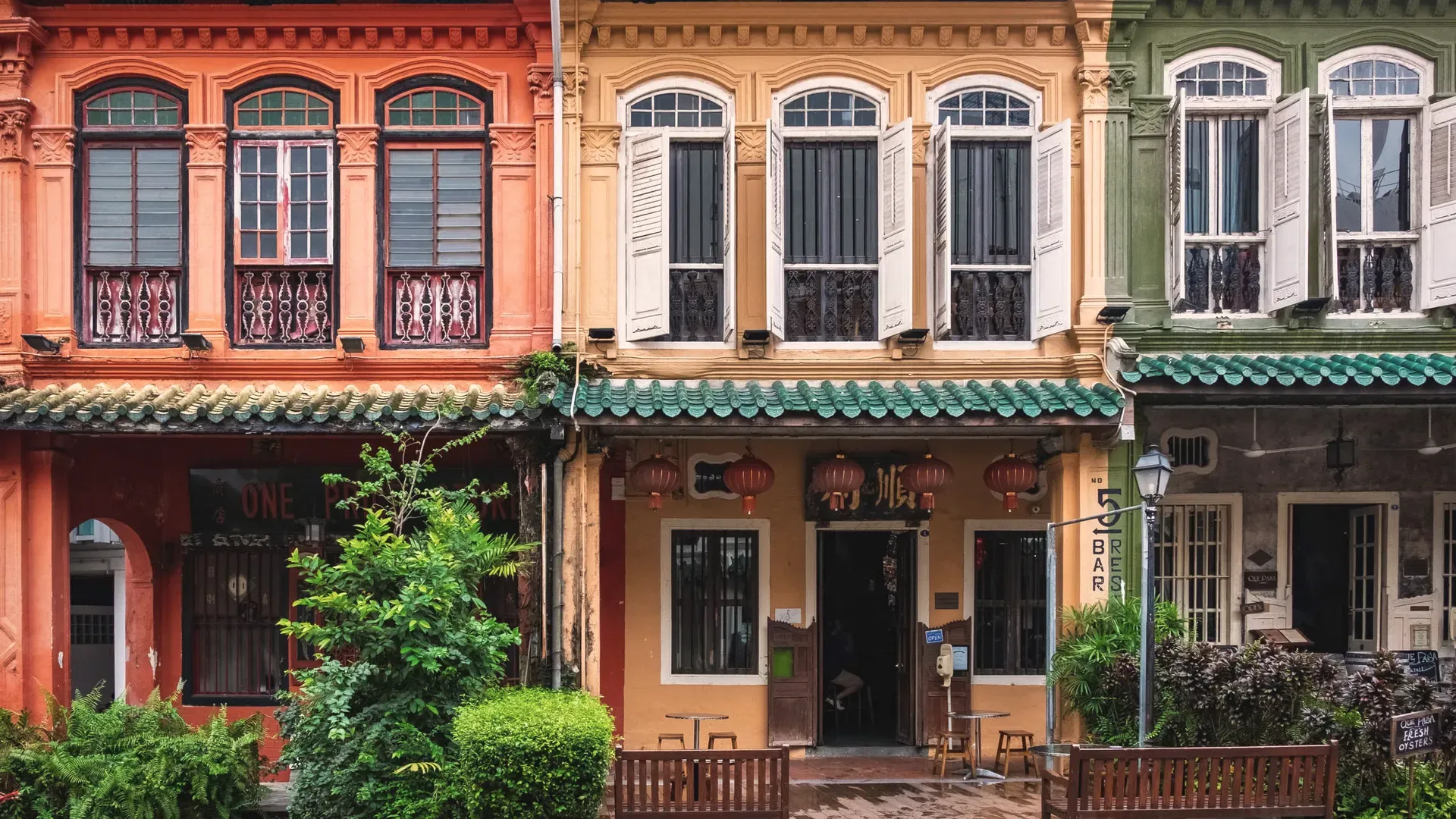
So the narrow concrete unit with a roll-down shutter at street level that most people picture is, in our reading, a tuek thaeo. A newer gated row of homes with a small front yard is usually built as a ban thaeo, which estate agents often call a townhouse. The difference matters because the regulation sets different sizes and open spaces for each, and because a building's permitted use is part of its permit.
What size and layout rules apply to a shophouse?
Ministerial Regulation No. 55 sets the shape of every new row. The clauses that shape daily life in a shophouse are these:
| Clause | Rule |
|---|---|
| 2, width and depth | Each unit of a row building or shophouse must be at least 4 meters wide, measured from the center line of the columns on one side to the other, between 4 and 24 meters deep, with a ground floor of at least 30 square meters, and must have doors for people to go in and out at both the front and the back |
| 2, deep units | If a unit is deeper than 16 meters, it needs an area open to the sky somewhere between 12 and 16 meters back, of at least 10 percent of the ground floor area |
| 2, floor level | A row on a public road must have its ground floor 10 centimeters above the footpath in front, or 25 centimeters above the middle of the road, as the case may be |
| 3, row houses | Each row house unit must also be at least 4 meters wide and 4 to 24 meters deep, with a ground floor of at least 24 square meters |
| 4, length of a row | No more than ten units in a row, and no more than 40 meters from the first column to the last, whether the units have one owner or several |
| 16, walls | The walls of a shophouse or row house must be of permanent, fire-resistant material; plain brick or unreinforced concrete walls must be at least 8 centimeters thick |
| 17, fire walls | Joined row buildings, shophouses or row houses need a fire wall at least every five units, running from the ground to the level of the roof deck; where the roof is not fire resistant, the fire wall must rise at least 30 centimeters above the roof |
| 34, space behind | A row building or shophouse must have an open space at least 3 meters wide behind it, linking the units, with no part of the building projecting into it except an outside fire escape stair projecting no more than 1.40 meters. A row whose front is not on a public road needs at least 6 meters of open space in front. These spaces may not be used for a building, fence, wall, well, pool or rubbish area |
Older rows are different. Clause 52, added by Ministerial Regulation No. 68 (B.E. 2563), says that row buildings, shophouses and row houses built before Regulation No. 55 took effect may be rebuilt or altered without meeting the width, row-length, front and side space and setback rules, provided the work adds no more than 2 percent to the total floor area first permitted, does not make the building taller, does not cover more ground, and keeps any open space or setback the building already has.
In practice (our reading), a unit in an old row may be narrower than 4 meters or sit in a row longer than ten units and still be lawful. What a renter can check is simpler: whether there is a usable back door and whether the space behind has been roofed or built over. If it has, ask the owner whether that work had a permit; our guide to building permits in Thailand explains how permits and change-of-use permits work.
What fire escape and fire safety rules matter in a shophouse?
A shophouse is narrow and deep, often with the only stair in the middle and grilles on the windows, so a fire on the ground floor can cut off the floors above. Ministerial Regulation No. 55 sets these rules for escape stairs:
- When a fire escape stair is required (clause 27): buildings of four stories or more and up to 23 meters high, and three-story buildings with a roof deck of more than 16 square meters above the third floor, need at least one fire escape stair made of fire-resistant material in addition to the normal stairs, with a way to reach it that is free of obstructions.
- Steeper stairs allowed (clause 28): fire escape stairs must be less steep than 60 degrees, except that shophouses and row houses of up to four stories may have a fire escape stair steeper than 60 degrees, with a landing at every floor.
- Outside stairs (clause 29): an outside fire escape stair must be at least 60 centimeters clear wide, against a solid fire-resistant wall; if it does not reach the ground floor, it needs a metal ladder that can slide, extend or drop down to the ground.
The Department of Disaster Prevention and Mitigation's booklet on fire (no date printed) explains why the way out matters: people caught in a fire have only about the first 2 minutes to escape safely, before the fire spreads and smoke thickens. Its advice for homes includes:
- Do not store things that block emergency exit doors or fire escape stairs, and keep flammable chemicals away from heat.
- Install fire equipment such as a fire extinguisher, smoke detectors and alarms at risk points such as the kitchen and the shrine room, and an automatic cut-out breaker at the electrical panel, and check them regularly.
- Do not leave mosquito coils, incense or candles burning unattended, and close the gas cylinder valve after every use.
- In a fire, do not go up to the upper floors or the roof, because fire spreads upward, unless you cannot get down; stay low under the smoke, and call for help on 199 (fire) with your location.
For a shophouse (our suggestions, not an official rule): make sure every window grille on the sleeping floors has at least one panel that opens from inside, keep its key next to it, know how to open the front shutter and the back door in the dark, and never park a motorbike or store stock across the back exit. Our property fire safety checklist and our guide to shower heaters and electrical safety cover alarms, earthing and wiring.
Who pays land and building tax when the ground floor is a shop?
The owner. Section 5 of the Land and Building Tax Act B.E. 2562 defines the taxpayer as the person or company that owns the land or the building, or that occupies or uses land or buildings that are state property, and includes anyone who must pay on the taxpayer's behalf. A tenant who rents a shophouse from a private owner is not the taxpayer under the Act.
A shophouse is often used two ways at once, a shop below and a home above. Section 38 deals with exactly that: where land or a building is put to more than one use, the local authority collects the tax in proportion to each use, under rules and methods announced jointly by the Minister of Finance and the Minister of Interior. Because the rates for homes and for other uses differ, a shop on the ground floor can change the owner's bill. Section 46 says the taxpayer pays the tax set in the assessment notice within April each year.
In practice (our reading): the Act puts the bill on the owner, but a lease can still pass the cost on, for example as a separate charge or inside the rent. If you plan to open a shop, tell the owner before you sign, agree in writing who bears any change in the tax, and read our guides to land and building tax and to appealing a land and building tax bill.
How does signboard tax work on a shop sign?
The sign over the shop is taxed separately, by the local authority, under the Signboard Tax Act B.E. 2510 (as amended in 2534). Section 6 defines a sign as one showing a name, brand or mark used in trade or another business to earn income, or advertising one, whatever it is shown on. Section 7 makes the owner of the sign liable, paying yearly; a sign first put up during the year is taxed in quarters, from the quarter it went up to the end of the year.
| Type of sign | Text or images move or change | Fixed sign |
|---|---|---|
| Thai text only | 10 baht | 5 baht |
| Thai mixed with foreign text, pictures or other marks | 52 baht | 26 baht |
| No Thai text, or some or all of the Thai below the foreign text | 52 baht | 50 baht |
The rates come from the regulation as reproduced in Hai Yong Subdistrict Municipality's notice dated 19 October 2569 on signboard tax for 2570; the municipality's own summary table prints 22 baht in both columns for mixed signs, while the regulation text it attaches says 52 and 26 baht. The Act's schedule sets how the area is measured: the widest part times the longest part of the sign's border (or of its outermost letters and marks if it has no border). A remainder over half of 500 square centimeters counts as a full 500; a smaller one is dropped. Any sign whose tax works out below 200 baht pays 200 baht.
A worked example (our arithmetic). A fixed sign 1 meter by 3 meters is 30,000 square centimeters, or 60 units of 500. In Thai only it would be 60 x 5 = 300 baht a year; in Thai and English, 60 x 26 = 1,560 baht; in English only, 60 x 50 = 3,000 baht.
- Filing: the owner of a taxed sign files a return in March each year (section 12) at the office of the local authority where the sign is (section 15). A sign put up after March, or changed so that more tax is due, must be declared within 15 days (section 14).
- Paying: within 15 days of receiving the assessment (section 19). Tax of 3,000 baht or more may be paid in three equal installments if you ask in writing before the due date (section 19 bis). The receipt must be displayed openly at the place of business (section 19 ter).
- Late or missing: not filing on time adds 10 percent (5 percent if you file before the officer tells you), and paying late adds 2 percent a month (section 25).
- Signs inside: signs shown inside a building used for business, each no larger than a size set by ministerial regulation, are exempt, but not the sign required by the commercial registration law (section 8 (5)).
- When nobody files: if no return was filed and the sign's owner cannot be found, the person in possession of the sign is liable, and failing that, the owner or occupier of the building or land where it hangs (section 18).
That last rule is why the sign belongs in the lease: if a previous tenant left a sign up, ask the owner to have it taken down or to agree in writing who pays for it. For the approvals a larger sign may also need, see our commercial signage approval checklist.
What is daily life like in a shophouse?
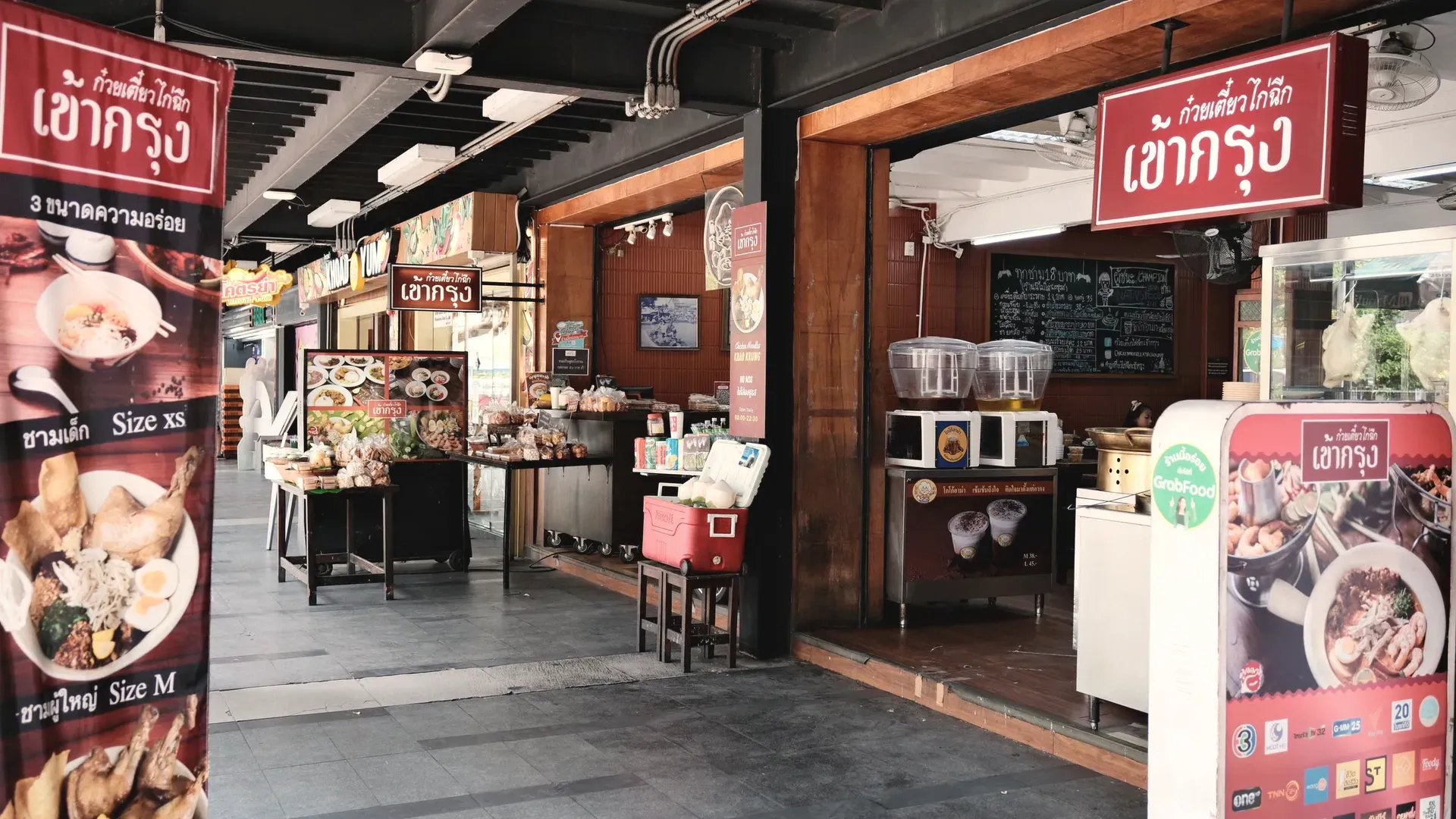
The building rules above explain much of the everyday experience (our observations, drawn from the rules rather than an official source):
- Light and air come from the ends. Units share side walls, so windows are usually only at the front and back; a deep unit may have an open well in the middle (clause 2).
- Noise travels along the street. Shops and traffic sit right below the bedrooms; ask what the neighbors run and when. Our guide to noise pollution covers the limits and complaints.
- Stairs are steep and narrow. Older units often have one stair; plan furniture and the move around it.
- The back lane is a fire route. The 3 meter space behind the row (clause 34) is meant to stay open; check it has not been closed off.
- Utilities are your own. Each unit usually has its own electricity and water meters; see our guides to utility bills and water pumps and storage tanks.
What should you ask before renting a shophouse?
Questions worth asking at a viewing (our suggestions, not an official list):
- Is there a usable back door, and is the lane behind open, not roofed or walled off?
- Do the window grilles and the front shutter open quickly from inside, and where are the keys kept?
- How many floors, and is there a roof deck? At four stories, or three with a roof deck of more than 16 square meters, the regulation expects a fire escape stair; ask where it is.
- What may the ground floor be used for? If you plan a shop, café or guesthouse, ask whether the building's permit covers it; our guide to building permits explains the change-of-use rule.
- Who pays land and building tax, and who pays if a shop changes the bill?
- Is there an old sign on the front, and who will pay its signboard tax or take it down?
- What is the state of the wiring, the breaker panel and the earth-leakage breaker? Ask for a smoke alarm on each sleeping floor.
- Can you register your address there if you need to? Our guide to house registration and house numbers explains the house book.
Write the answers into the lease. Our guides to understanding your Thai lease and to commercial lease types cover the clauses, and our renters insurance guide covers what a policy pays after a fire.
Frequently asked questions
Ministerial Regulation No. 55 (B.E. 2543) under the Building Control Act uses three terms. A row building (hong thaeo) is a building of two or more units built in a continuous row, divided by walls and made mostly of materials that are not fire resistant. A shophouse (tuek thaeo) is the same kind of row but made mostly of fire-resistant materials. A row house (ban thaeo) is a row building or shophouse used as a home, with open space at the front and back between the fence or boundary and each unit, and no more than three stories high.
Clause 2 of Ministerial Regulation No. 55 says each unit of a row building or shophouse must be at least 4 meters wide, measured between the center lines of the columns, between 4 and 24 meters deep, have a ground floor of at least 30 square meters, and have doors for people to go in and out at both the front and the back. Clause 52, added in 2020, exempts older rows built before the regulation from the width rule when they are rebuilt or altered within set limits.
Clause 27 of Ministerial Regulation No. 55 requires a fire escape stair made of fire-resistant material, in addition to the normal stairs, in buildings of four stories or more and up to 23 meters, and in three-story buildings with a roof deck of more than 16 square meters above the third floor. Clause 28 lets shophouses and row houses of up to four stories have a fire escape stair steeper than 60 degrees, with a landing at every floor.
Under section 5 of the Land and Building Tax Act B.E. 2562, the taxpayer is the owner of the land or building (or the person who occupies or uses state property). Section 38 says that when land or a building is put to more than one use, the local authority taxes it in proportion to each use. A tenant is not the taxpayer under the Act, but a lease can say who bears the cost, so read that clause before you sign.
Under the Ministerial Regulation setting signboard tax rates B.E. 2563, which applies from 1 January 2564 (2021), a fixed sign costs 5 baht per 500 square centimeters if it is in Thai only, 26 baht if Thai is mixed with foreign text, pictures or marks, and 50 baht if it has no Thai or the Thai sits below the foreign text. Signs whose text or images move or change cost 10, 52 and 52 baht. The Signboard Tax Act's schedule sets a minimum of 200 baht per sign.
Section 12 of the Signboard Tax Act says the owner of a sign that is taxed files a return in March of each year. A sign put up after March, or changed in a way that raises the tax, must be declared within 15 days of putting it up or changing it (section 14). Tax is paid within 15 days of receiving the assessment (section 19), and the receipt must be displayed openly at the place of business (section 19 ter).
Check that the unit has a way out at the back as well as the front, that window grilles and roll-down shutters can be opened quickly from inside, that the fire escape route or roof access is clear, who pays land and building tax and any signboard tax, whether the ground floor may be used for the business you plan, and the condition of the wiring. These are our suggestions; section 07 of this guide lists them in full.
Looking for a shophouse or townhouse?
Browse homes and commercial units listed by partnered agents, and ask about the back door, the fire route and the taxes before you sign.
Sources
- Ministerial Regulation No. 55 (B.E. 2543) issued under the Building Control Act B.E. 2522, Royal Gazette vol. 117 part 75 Kor, 7 August 2543 (2000), Office of the Council of State consolidated text as amended up to Ministerial Regulation No. 68 (B.E. 2563), Thai PDF hosted on the Official Information Commission infocenter: clause 1 definitions of row building (hong thaeo), shophouse (tuek thaeo), row house (ban thaeo) and twin house, clause 2 units at least 4 m wide, 4 to 24 m deep, ground floor at least 30 sq m, doors front and back, clause 3 row houses, clause 4 at most ten units and 40 m per row, clause 16 fire-resistant walls, clause 17 a fire wall at least every five units, clauses 27 to 29 fire escape stairs, clause 34 open space at least 3 m behind a row, clause 52 (added by No. 68) rebuilding older rows ↗Office of the Council of State · Accessed 24 November 2026
- Land and Building Tax Act B.E. 2562 (2019), signed 9 March 2562, Royal Gazette PDF (Thai): section 5 taxpayer is the owner of the land or building, or the occupier or user of state property, section 38 land or buildings with more than one use taxed in proportion to each use under rules announced jointly by the Ministers of Finance and Interior, section 46 payment under the assessment notice within April each year ↗Royal Thai Government Gazette · Accessed 24 November 2026
- Signboard Tax Act B.E. 2510 (1967) as amended by the Signboard Tax Act (No. 2) B.E. 2534, Thai text in PDF on the Department of Intellectual Property site: section 6 definition of a sign, section 7 the sign owner pays yearly, by quarters in the first year, section 8 (5) exemption for signs inside a business building up to a size set by ministerial regulation, section 12 return filed in March, section 14 new or changed signs within 15 days, section 15 where to file, section 18 possessor, then building or land owner or occupier liable when the owner cannot be found, section 19 payment within 15 days of assessment, section 19 bis three installments from 3,000 baht, section 19 ter display the receipt, section 25 surcharges of 10 or 5 percent and 2 percent a month, schedule items (6) area and (7) rounding and 200 baht minimum ↗Department of Intellectual Property (copy of the Act) · Accessed 24 November 2026
- Hai Yong Subdistrict Municipality (Sakon Nakhon) notice dated 19 October 2569 on signboard tax rates for 2570, with the attached Ministerial Regulation setting signboard tax rates B.E. 2563 (signed 10 November 2563, Royal Gazette vol. 137 part 98 Kor, 3 December 2563, rates from 1 January 2564): per 500 sq cm, Thai only 10 baht (moving or changing) and 5 baht (fixed), Thai mixed with foreign text or images 52 and 26 baht, no Thai or Thai below foreign text 52 and 50 baht; the notice summary table prints 22 baht for mixed signs ↗Hai Yong Subdistrict Municipality · Accessed 24 November 2026
- Department of Disaster Prevention and Mitigation (DDPM), booklet on fire (Thai PDF, no date printed, read 24 November 2026): about 2 minutes to escape safely, keep exits and fire stairs clear, extinguishers, smoke detectors and alarms at risk points such as the kitchen and shrine room, automatic cut-out breaker at the panel, do not go to upper floors or the roof unless you cannot get down, fire number 199 ↗Department of Disaster Prevention and Mitigation · Accessed 24 November 2026
Official primary sources are listed above with the date we last checked them. Thai rules, fees, thresholds and procedures change and can be applied differently by individual offices and embassies, confirm the current requirement with the responsible authority before relying on it. General information only, not legal, tax or medical advice. BAANLYY never takes paid placement in editorial content.