The short answer
The neighbor rules sit in Book 4 of the Civil and Commercial Code, in the chapter on the extent and exercise of ownership (sections 1335 to 1355). They apply between owners of adjoining land without any contract. Distances for fences and house walls come from a separate source, Ministerial Regulation No. 55 under the Building Control Act.
| Question | The rule | Source |
|---|---|---|
| A wall, fence, hedge or ditch that marks the boundary | Presumed to belong to the owners of the land on both sides in common | Code, s.1344 |
| Shares and costs of a thing owned in common | Shares are presumed equal, and each co-owner contributes in proportion to their share to the costs of management, taxes and upkeep | Code, ss.1357 and 1362 |
| A well, pond, cesspool or pit for manure or refuse | May not be dug within two meters of the boundary line | Code, s.1342 |
| A ditch or trench for underground pipes | No nearer to the boundary than half its depth, but allowed at one meter or more | Code, s.1342 |
| Excavating or loading land | Not to a degree that may endanger the stability of the adjoining land, unless enough is done to prevent damage | Code, s.1343 |
| Roof water | A roof or other structure may not make rainwater fall onto the adjoining property | Code, s.1341 |
| Stepping onto the next plot | After reasonable notice, as far as necessary to build or repair a fence, wall or building on or near the boundary line, but not into the neighbor's dwelling house without consent | Code, s.1351 |
| A fence or wall beside a public road | No higher than 3 meters above the footpath or the public road | Regulation No. 55, clause 47 |
| A house wall with windows or a balcony | At least 2 meters from the boundary for a building no higher than 9 meters, 3 meters for a building higher than 9 meters but under 23 meters | Regulation No. 55, clause 50 |
Code sections are from the Thai consolidated text of the Civil and Commercial Code on the Office of the Council of State law search, read on 15 November 2026. Regulation No. 55 (B.E. 2543) was read as gazetted on 7 August 2000. English wording is our own rendering.
Every one of these rules assumes that the boundary itself is known. Where the line is in doubt, start with our land boundary and survey guide and the boundary resolution checklist before reading a wall as yours or as shared.
Who owns a boundary wall or fence in Thailand?
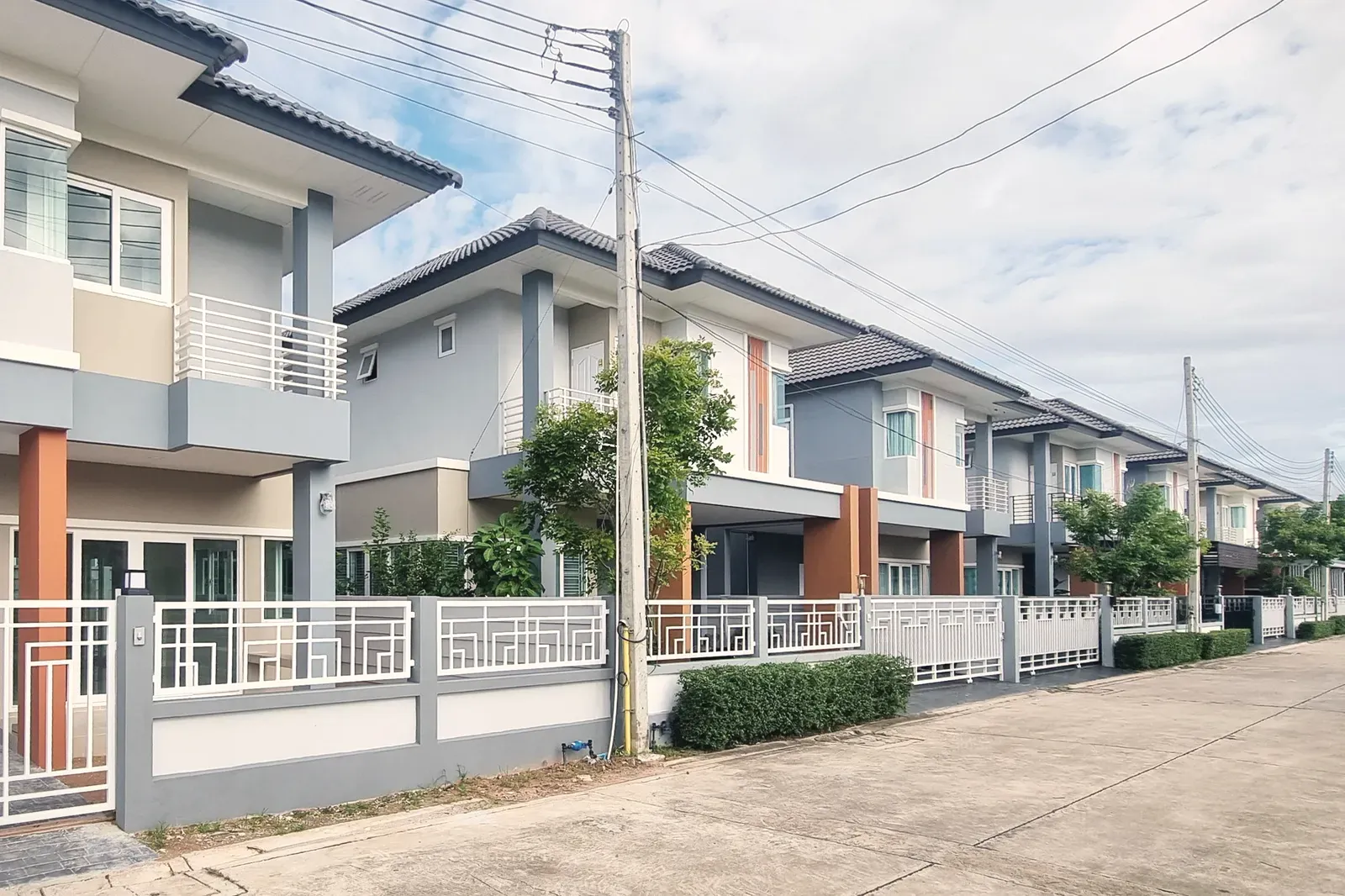
Section 1344 answers in one sentence: a fence, a wall, a hedge or a ditch that marks the boundary of land is presumed to belong to the owners of the land on both sides in common. Thai law calls this co-ownership, kammasit ruam, and the Code has a chapter of its own on it.
Two words in the section carry the weight. The first is marks. The presumption covers a fence, wall, hedge or ditch that marks the boundary. The section does not speak of a wall that stands wholly inside one plot. The second is presumed. A presumption holds until the contrary is shown, so a wall on the line is treated as shared unless one owner can show that it is theirs alone.
| Section | What it says |
|---|---|
| 1335 | Subject to this Code and other laws, the ownership of land extends above and below the surface |
| 1336 | Within the limits of the law, an owner has the right to use and dispose of the property, to take its fruits, to follow and recover it from a person who has no right to hold it, and to prevent unlawful interference with it |
| 1344 | A fence, wall, hedge or ditch that marks the boundary of land is presumed to belong to the owners of the land on both sides in common |
| 1346 | A tree on the boundary line is presumed to belong to the owners of the land on both sides in common |
Civil and Commercial Code, ss.1335, 1336, 1344 and 1346.
The section does not say what evidence displaces the presumption, and no court decision was read for this guide. Records are the place to start: a survey that shows where the wall stands against the boundary markers, the building papers that show who put it up, and any written agreement between the two owners. Keep those with the title papers. Our guide to Thai title deeds explains what the deed itself records.
In a housing estate the wall between two plots is often built by the developer before either buyer arrives. Section 1344 makes no exception for a wall built by a developer. Check the estate's own rules as well before changing one. Our guide to housing estate buyer protections covers the developer side.

Who pays to build or repair a boundary wall?
The neighbor sections say nothing about money for a wall. Sections 1335 to 1355, read in full for this guide, contain no rule that obliges a neighbor to pay toward a new wall or fence. What they do is make a boundary wall presumed co-owned, and the chapter on co-ownership (sections 1356 to 1366) then supplies the rules on cost and decisions. Section 1356 says that chapter applies where property belongs to several persons in common, unless the law provides otherwise.
| Point | The rule for a thing owned in common | Section |
|---|---|---|
| Shares | Co-owners are presumed to have equal shares | 1357 |
| Costs | Each co-owner must contribute, in proportion to their share, to the costs of management, taxes and upkeep and to the costs of common use | 1362 |
| Keeping it standing | Each co-owner may always do acts to preserve the property | 1358 |
| Ordinary management | Decided by a majority of the co-owners; each co-owner may do an act of ordinary management unless the majority has decided otherwise | 1358 |
| Important management | Decided by a majority of the co-owners who together hold at least half the value of the property | 1358 |
| Changing its purpose | Only with the agreement of every co-owner | 1358 |
| Use | Each co-owner may use the property, but not in a way that conflicts with the rights of the others | 1360 |
| Disposing of the thing itself | Disposing of, pledging, mortgaging or encumbering the property itself needs the consent of every co-owner | 1361 |
Civil and Commercial Code, ss.1356 to 1358 and 1360 to 1362.
Read together, the sections give a workable order for a shared wall. Section 1358 lets either owner act alone to preserve it. Section 1362 then makes each co-owner contribute to upkeep in proportion to their share, and section 1357 presumes the shares are equal. The Code does not sort wall work into preserving, ordinary management and important management, and this guide does not say where a court draws those lines.
A wall that one owner builds wholly inside their own plot is a different case. Section 1344 speaks of a wall that marks the boundary, and the co-ownership sections apply only to property that belongs to several persons in common.
Agree in writing with the neighbor on where the wall will stand, who pays for what and who repairs it, and keep the paper with the title documents. The Code presumes; a signed record shows. For land held by more than one person, see our guide to a property co-ownership agreement.
Hedges, ditches and trees on the boundary
Four sections deal with living boundaries and with trees. They are short, and each one states who may act.
| Situation | What the Code says | Section |
|---|---|---|
| A shared hedge, or a shared ditch that is not used as a drain | Either owner may cut the hedge or fill the ditch up to their own boundary line, but must then build a wall or put up a fence along that line | 1345 |
| A tree on the boundary line | Presumed to belong to both owners in common; its fruits belong to them in equal shares, and so does the timber if it is felled | 1346 |
| Removing a tree on the line | Either owner may require it to be dug up or cut, and the cost is shared equally; if the other owner gives up their right in the tree, the owner who wants it removed bears the cost alone | 1346 |
| A tree that serves as a boundary mark | Neither owner may require it to be dug up or cut where it is a boundary mark and no other mark would be as suitable | 1346 |
| Roots from the next plot | The owner of the land may cut them off and keep them | 1347 |
| Overhanging branches | The owner must first tell the possessor of the adjoining land to cut them within a reasonable time; if that person does not, the owner may cut them | 1347 |
| Fruit that falls naturally onto adjoining land | Presumed to be fruit of the land it falls on | 1348 |
Civil and Commercial Code, ss.1345 to 1348.
Section 1345 is the only neighbor section that tells an owner to build a boundary wall or fence. It applies to the owner who chooses to cut down a shared hedge or fill a shared ditch, and it places the duty on that owner. A ditch that is used as a drain is outside the section.
Roots and branches follow different steps. The section sets no notice step for roots. Branches need a request first, and the request goes to the possessor of the adjoining land, which is the word the section uses. Send it in writing with a date and a photograph so that the reasonable time can be shown later. Where a building, and not a tree, crosses the line, the rules are in our guide to building on someone else's land.

How close to the boundary can a neighbor dig?
Section 1342 sets two distances and one duty of care. Section 1343 adds a general rule against digging or loading land in a way that puts the next plot at risk.
| Work | The limit | Section |
|---|---|---|
| A well, a pond, a cesspool, or a pit for manure or refuse | May not be dug within two meters of the boundary line | 1342, first paragraph |
| A ditch, or a trench for laying underground water pipes or similar things | May not be made nearer to the boundary line than half the depth of the ditch or trench; at a distance of one meter or more it may be made | 1342, second paragraph |
| Any of that work done near the boundary | Due care must be used to prevent earth or sand from collapsing and water or filth from seeping through | 1342, third paragraph |
| Digging out earth, or placing weight on land | Not to a degree that may endanger the stability of the adjoining land, unless enough is done to prevent damage | 1343 |
Civil and Commercial Code, ss.1342 and 1343.
The trench rule is easier to see with numbers. The figures here are our own arithmetic on the section, not examples from the Code. A trench 1.20 meters deep may come no nearer than 0.60 meters, half its depth. A trench 3 meters deep would need 1.50 meters on the half-depth test, but the section allows any trench at one meter or more, so one meter is enough.
The first paragraph uses the Thai word sa, which means a pond and is also the everyday word for a swimming pool. The Code does not mention swimming pools by name, and this guide does not say how a court treats one. The cesspool wording matters for any house that is not on a public sewer: the pit that receives waste water is one of the things the section keeps two meters from the line. Our septic and wastewater checklist covers the system itself.
Section 1343 has no distance in it. It looks at the result: digging out earth, or loading land with weight, beyond what is proper so that it may endanger the stability of the adjoining land is prohibited, unless enough is done to prevent damage. Deep foundations, a basement, a retaining wall and a raised plot of fill beside a lower neighbor are the works to check against that sentence.
Section 1338 explains how firmly these limits hold. Restrictions that the law places on the rights of an owner of immovable property need not be registered. They cannot be removed or relaxed by a juristic act unless the act is made in writing and registered with the competent official, and restrictions set in the public interest cannot be removed or relaxed at all. This guide does not say which rules a court treats as restrictions under that section, but a spoken promise from a neighbor that a pit can go closer to the line is a weak thing to build on.

Roof water, and use of land that goes beyond the ordinary
Section 1341 is a single sentence: an owner of immovable property may not build a roof or any other structure that makes rainwater fall onto the adjoining property. A roof edge, a canopy or an awning that sheds water over the line fits those words. Gutters and a downpipe that bring the water down inside the owner's own plot are the ordinary answer.
Section 1337 is the general rule behind most neighbor complaints. Where a person, in exercising a right, causes the owner of immovable property damage or trouble beyond what is normally and reasonably to be expected, having regard to the nature and location of that property, the owner has the right to act to end the damage or trouble. The section adds that this does not take away the right to claim compensation.
| Section | What it says |
|---|---|
| 1337 | Damage or trouble beyond what is normally and reasonably to be expected, given the nature and location of the property, may be brought to an end by the owner who suffers it, without losing the right to compensation |
| 1339 | An owner of land must accept water that flows naturally onto it from higher land |
| 1340 | An owner of land must accept water drained from higher land if that water already flowed onto the land naturally before the drainage; a lower owner who suffers damage from the drainage may require the higher owner to make a drain, at the higher owner's expense, through the lower land to a public waterway or drain |
| 1341 | No roof or other structure may make rainwater fall onto the adjoining property |
| 421 | The exercise of a right that can only cause damage to another person is unlawful |
Civil and Commercial Code, ss.421, 1337 and 1339 to 1341.
The test in section 1337 is tied to the place. The same smoke, smell, vibration or light is judged against what is normal for a property of that kind in that location, and the Code gives no list and no decibel or distance figure. Water between plots is covered in more depth in our drainage maintenance checklist, and sound in our guide to noise and neighbor disputes.

Can a neighbor come onto your land to repair a wall?
Yes, within limits. Section 1351 says an owner of land may, after giving reasonable notice, use the adjoining land as far as necessary to build or repair a fence, a wall or a building on or near their own boundary line. The same section draws a line at the home: the owner may not go into the neighbor's dwelling house unless the neighbor consents. Its second paragraph says that if damage is caused, the neighbor may claim compensation.
| Element of section 1351 | What it means for the work |
|---|---|
| Reasonable notice | The owner must tell the neighbor in advance; the section gives no number of days |
| As far as necessary | The use of the next plot is limited to what the building or repair needs |
| Fence, wall or building on or near the boundary line | The work must be building or repairing a fence, wall or building at or near the owner's own boundary line |
| Not the dwelling house | Entering the neighbor's home needs the neighbor's consent |
| Damage | The neighbor may claim compensation for damage that the work causes |
Civil and Commercial Code, s.1351.
The section works in both directions. It is the section a neighbor relies on to stand scaffolding on your side while rendering a wall on the line, and the one you rely on to ask the same of them. Put the notice in writing, state the dates and the work, photograph the neighbor's side before starting and make good what is disturbed.
Section 1352 is the companion rule for services. An owner of land who receives reasonable compensation must allow water pipes, drain pipes, electric wires or similar things to be laid across the land for the benefit of adjoining land, where they could not otherwise be laid or could be laid only at excessive cost. The owner may ask for their own interests to be taken into account. A right to cross land on foot or by car is a different matter, covered in our land access and servitude checklist.
Fence height, and how close a house wall can stand
The Code says who owns a wall. Height and distance come from building control law. Ministerial Regulation No. 55 (B.E. 2543), issued under the Building Control Act B.E. 2522, sets general figures for fences beside public roads and for the gap between a building wall and the boundary of the plot.
| Subject | What the regulation says | Clause |
|---|---|---|
| A fence or wall beside a public road | A fence or wall built adjoining a public road, or nearer to it than the height of the fence, may be built no higher than 3 meters above the level of the footpath or the public road | 47 |
| A boundary fence or wall at a street corner | At the corner of public roads 3 meters wide or more that meet at an angle of less than 135 degrees, the corner of the fence or wall must be cut back, with a cut of at least 4 meters at equal angles to the two roads | 5 |
| A wall with windows, doors, vents or light openings, or a balcony: building no higher than 9 meters | The wall or balcony must be at least 2 meters from the boundary of the land | 50 (1) |
| The same: building higher than 9 meters but under 23 meters | The wall or balcony must be at least 3 meters from the boundary of the land | 50 (2) |
| A wall nearer than those distances | It must be at least 50 centimeters from the boundary, unless it is built right on the boundary, and in that case the building may be no higher than 15 meters; the wall must be a solid wall, and a roof deck on that side needs a solid wall at least 1.80 meters high | 50, second paragraph |
| Building right on the boundary | Needs the written consent of the owner of the adjoining land on that side | 50, second paragraph |
| A row house (ban thaeo) | Open space at least 3 meters wide at the front and 2 meters at the back, between the fence or boundary and the wall of the building | 36 |
| A semi-detached house (ban faet) | Open space of at least 3 meters at the front, 2 meters at the back and 2 meters at the side | 37 |
Ministerial Regulation No. 55 (B.E. 2543) under the Building Control Act B.E. 2522, clauses 5, 36, 37, 47 and 50, as gazetted on 7 August 2000 (Government Gazette volume 117, part 75 Kor).
Clause 47 is narrower than it is often quoted. It limits a fence or wall that adjoins a public road or stands closer to one than its own height. The regulation as read has no clause that sets a height for a fence between two private plots away from a road.
Clause 50 is the one that settles most arguments about a new house next door. A wall with any opening in it, or a balcony, keeps 2 or 3 meters from the line depending on the height of the building. A solid wall may come to 50 centimeters. A wall on the line itself needs the adjoining owner's consent in writing, so under this clause a wall on your boundary needs your consent on paper.
This guide read Regulation No. 55 in the text gazetted on 7 August 2000. It did not check whether later regulations have amended these clauses, and it did not read any local bylaw or town plan. Before building, or before objecting to a neighbor's building, ask the local building control office which figures apply to the plot. Our guide to building permits in Thailand explains where and how a permit is applied for.
What if a wall, building or tree causes damage?
A leaning wall or a dead tree beside the line raises a different question: who answers for it when it falls. The rules are in the title on wrongful acts, in Book 2 of the Code.
| Section | What it says |
|---|---|
| 420 | A person who, willfully or negligently, unlawfully injures the life, body, health, liberty, property or any right of another commits a wrongful act and must pay compensation for it |
| 434, first paragraph | Where damage is caused because a building or other structure is defectively built or not adequately maintained, the possessor of the building or structure must pay compensation; if the possessor used proper care to prevent the damage, the owner must pay compensation |
| 434, second paragraph | The same rule applies to defects in the planting or propping of trees or bamboo clumps |
| 434, third paragraph | Where another person is also responsible for causing the damage, the possessor or the owner may claim against that person in turn |
| 435 | A person who is about to suffer damage from another person's building or other structure is entitled to require that what is necessary be done to avert the danger |
| 448 | A claim for damages arising from a wrongful act is barred one year from the day the injured person knew of the wrongful act and of the person bound to pay compensation, or ten years from the day the wrongful act was committed |
Civil and Commercial Code, ss.420, 434, 435 and 448.
Section 435 is the one to use early. It does not wait for the wall to come down. A person who is about to suffer damage from a structure that belongs to someone else may require what is necessary to avert the danger. A dated letter with photographs that asks for the repair, and names the section, puts the request on record.
Section 434 places the claim on the possessor first and on the owner where the possessor used proper care, so a rented house next door can mean two names to write to. The one-year period in section 448 is short. Our guide to the statute of limitations in Thailand explains how periods are counted and what interrupts them.

Steps for an owner, and for a buyer before signing
Each step below follows from a section or clause set out above.
- Find the line before judging the wall. Section 1344 presumes co-ownership of a wall that marks the boundary. Have the boundary markers located against the title deed before deciding whether a wall is on the line or inside one plot.
- Ask the seller about every boundary structure. Who built each wall, who has repaired it, and whether anything is written down with the neighbor.
- Measure pits, pools and trenches. Section 1342 keeps a well, pond, cesspool or refuse pit two meters from the line and a trench at least half its depth from the line, with one meter always enough.
- Look up at the roof edges. Under section 1341 a roof or other structure may not make rainwater fall onto the adjoining property. Check your side and theirs.
- Check walls with openings against clause 50. A wall with windows or a balcony belongs 2 or 3 meters from the boundary, and a solid wall 50 centimeters, unless the adjoining owner consented in writing to a wall on the line.
- Give notice before stepping across. Section 1351 allows the use of the next plot for building or repair after reasonable notice, and never the neighbor's dwelling house without consent.
- Ask before you cut branches. Section 1347 lets an owner cut roots, but branches only after the possessor of the next plot has been told to cut them and a reasonable time has passed.
- Write to the neighbor when a structure looks unsafe. Section 435 lets a person who is about to suffer damage require what is necessary to avert the danger.
- Put agreements with a neighbor in writing. Under section 1338 a restriction set by law cannot be removed or relaxed by a juristic act unless the act is in writing and registered with the competent official.
The Civil and Commercial Code was read in Thai in the latest consolidated text on the Office of the Council of State law search on 15 November 2026. Ministerial Regulation No. 55 (B.E. 2543) was read in Thai as gazetted on 7 August 2000, in a copy published by the Hydro-Informatics Institute; later amendments, local bylaws and town plans were not read. No court decision was read, so the guide does not say what displaces the presumption in section 1344, how a court sorts wall work under section 1358, or what counts as reasonable notice or a reasonable time. Whether a fence or wall needs a building permit is not covered. The trench figures are our own arithmetic.
For a purchase, these checks sit inside wider due diligence. See our guides to house purchase due diligence, to adverse possession, which is the rule on acquiring ownership through long possession, and to hiring a lawyer in Thailand for a dispute that is already live.

Frequently asked questions
Section 1344 of the Civil and Commercial Code says a fence, wall, hedge or ditch that marks the boundary of land is presumed to belong to the owners of the land on both sides in common. It is a presumption, so it holds until the contrary is shown. The section does not say what evidence shows the contrary, and this guide does not say how a court weighs it.
The neighbor sections of the Civil and Commercial Code read for this guide, sections 1335 to 1355, contain no rule that obliges a neighbor to pay toward a new wall or fence. Where a wall is owned in common, section 1362 says each co-owner must contribute in proportion to their share to the costs of management, taxes and upkeep, and section 1357 presumes the shares are equal.
Section 1342 of the Civil and Commercial Code says a well, a pond, a cesspool or a pit for manure or refuse may not be dug within two meters of the boundary line. A ditch or trench for underground water pipes or similar things may not be made nearer to the boundary than half its depth, but may be made at a distance of one meter or more. Work done near the boundary must be done with due care to stop earth or sand from collapsing and water or filth from seeping through.
Section 1351 of the Civil and Commercial Code says an owner of land may, after giving reasonable notice, use the adjoining land as far as necessary to build or repair a fence, wall or building on or near the boundary line. The owner may not enter the neighbor's dwelling house without consent. If damage is caused, the neighbor may claim compensation.
Section 1347 of the Civil and Commercial Code says an owner of land may cut off and keep roots that have come in from adjoining land. For overhanging branches, the owner must first tell the possessor of the adjoining land to cut them within a reasonable time. If that person does not, the owner may cut them.
Clause 47 of Ministerial Regulation No. 55 (B.E. 2543) under the Building Control Act says a fence or wall built adjoining a public road, or nearer to a public road than its own height, may be built no higher than 3 meters above the level of the footpath or the public road. The clause speaks of fences by a public road. This guide read the regulation as gazetted in 2000 and did not check later amendments or local bylaws, so confirm the figure with the local building control office.
Clause 50 of Ministerial Regulation No. 55 (B.E. 2543) says a building wall with windows, doors, vents or light openings, or a balcony, must stand at least 2 meters from the boundary where the building is no higher than 9 meters, and at least 3 meters where it is higher than 9 meters but under 23 meters. A wall nearer than that must be a solid wall at least 50 centimeters from the boundary, and building right on the boundary needs the written consent of the owner of the adjoining land on that side. This guide read the regulation as gazetted in 2000 and did not check later amendments.
Section 1341 of the Civil and Commercial Code says an owner of immovable property may not build a roof or other structure that makes rainwater fall onto the adjoining property. Section 1337 adds a general rule: where a person exercising a right causes the owner of immovable property damage or trouble beyond what is normally and reasonably to be expected, that owner has the right to act to end it and may still claim compensation.
Know where the line is before you build beside it
Read how a boundary survey works, or find a surveyor to locate the markers on the ground.
General information only, not legal advice. Rules are from the Civil and Commercial Code (sections 420, 421, 434, 435, 448 and 1335 to 1364) in the Thai consolidated text on the Office of the Council of State law search, read on 15 November 2026, and from Ministerial Regulation No. 55 (B.E. 2543) under the Building Control Act as gazetted on 7 August 2000. English wording is our own rendering. Laws change and each case turns on its own facts and documents.
Sources
- Civil and Commercial Code (Thai, latest consolidated text, status in force): Book 4, Title 2 Ownership, Chapter 2 Extent and exercise of ownership, ss.1335-1338 the owner's rights and restrictions set by law, ss.1339-1341 water and roof water, ss.1342-1343 digging near the boundary, ss.1344-1348 boundary walls, fences, hedges, ditches and trees, ss.1351-1352 using adjoining land to build or repair and laying pipes and wires; Chapter 3 Co-ownership, ss.1356-1358 and 1360-1362; with ss.420, 421, 434, 435 and 448 on wrongful acts ↗Office of the Council of State · Accessed 15 November 2026
- Ministerial Regulation No. 55 (B.E. 2543) under the Building Control Act B.E. 2522 (Thai, as gazetted on 7 August 2000, Government Gazette volume 117 part 75 Kor; later amendments not shown): clause 5 corner cut for a boundary fence or wall, clauses 36 and 37 open space for row houses and semi-detached houses, clause 47 fence height beside a public road, clause 50 distance of walls and balconies from the boundary ↗Ministry of Interior, copy published by the Hydro-Informatics Institute (Public Organization) · Accessed 15 November 2026
Official primary sources are listed above with the date we last checked them. Thai rules, fees, thresholds and procedures change and can be applied differently by individual offices and embassies, confirm the current requirement with the responsible authority before relying on it. General information only, not legal, tax or medical advice. BAANLYY never takes paid placement in editorial content.