Rent by area, food from local markets to Isaan specialties, songthaews and the flight to Bangkok, utilities, healthcare and schooling, with three realistic budgets for Isaan's education and healthcare capital. Figures are 2026 guide ranges in Thai baht (≈ THB 33.5–34 = USD 1, late October 2026).
Share
Overview
The short version
Khon Kaen is one of the more affordable cities in Thailand for a foreigner to live well in, similar to Udon Thani and comfortably under Chiang Mai, Phuket or Bangkok. A lean, local lifestyle runs roughly THB 20,000–32,000 a month; a comfortable mid-expat lifestyle runs roughly THB 35,000–55,000; and a premium or family lifestyle with a car runs roughly THB 50,000–90,000 before school fees. Rent is the biggest lever, it swings between suburban budget living and the Central Plaza, Bueng Kaen Nakhon lakefront and Khon Kaen University (KKU) / Srinagarind Hospital corridor, and international school fees are the biggest swing factor for families. Everything below is a current guide range; start with the BAANLYY Khon Kaen hub for the full picture.
Rent, monthly, by area tier
Furnished condo and townhome units are the norm for foreigners in Khon Kaen's smaller but growing rental market. The KKU/Srinagarind corridor and the Bueng Kaen Nakhon lakefront carry the city's clearest premiums, driven by university, hospital and lifestyle demand; suburban Khon Kaen outside the center remains the cheapest way to live in the city. Prices are monthly rent in THB.
Tier
Example areas
Studio
1-bed
2-bed
Value / suburban
Outskirts & suburban Khon Kaen, outside the center
3,500–5,500
5,000–7,000
8,000–12,000
University / hospital corridor
Khon Kaen University (KKU) & Srinagarind Hospital area
5,000–7,000
6,500–9,500
10,000–15,000
City center
Central Plaza & Fairy Plaza area
5,000–7,500
7,000–10,000
11,000–16,000
Lakefront
Bueng Kaen Nakhon lakefront
5,500–8,000
8,000–12,000
12,000–18,000
Food & groceries
Item
Typical cost
Local Thai meal at a market or food stall
THB 35–60
Isaan specialties, som tam, larb, sticky rice, at a local restaurant
THB 60–120
Casual Thai restaurant, mains
THB 70–160
Mid-range restaurant for two
THB 350–800
Central Plaza / Fairy Plaza food court meal
THB 60–150
Café latte / specialty coffee
THB 55–100
Monthly groceries, couple (mix of local + imported)
THB 6,000–11,000
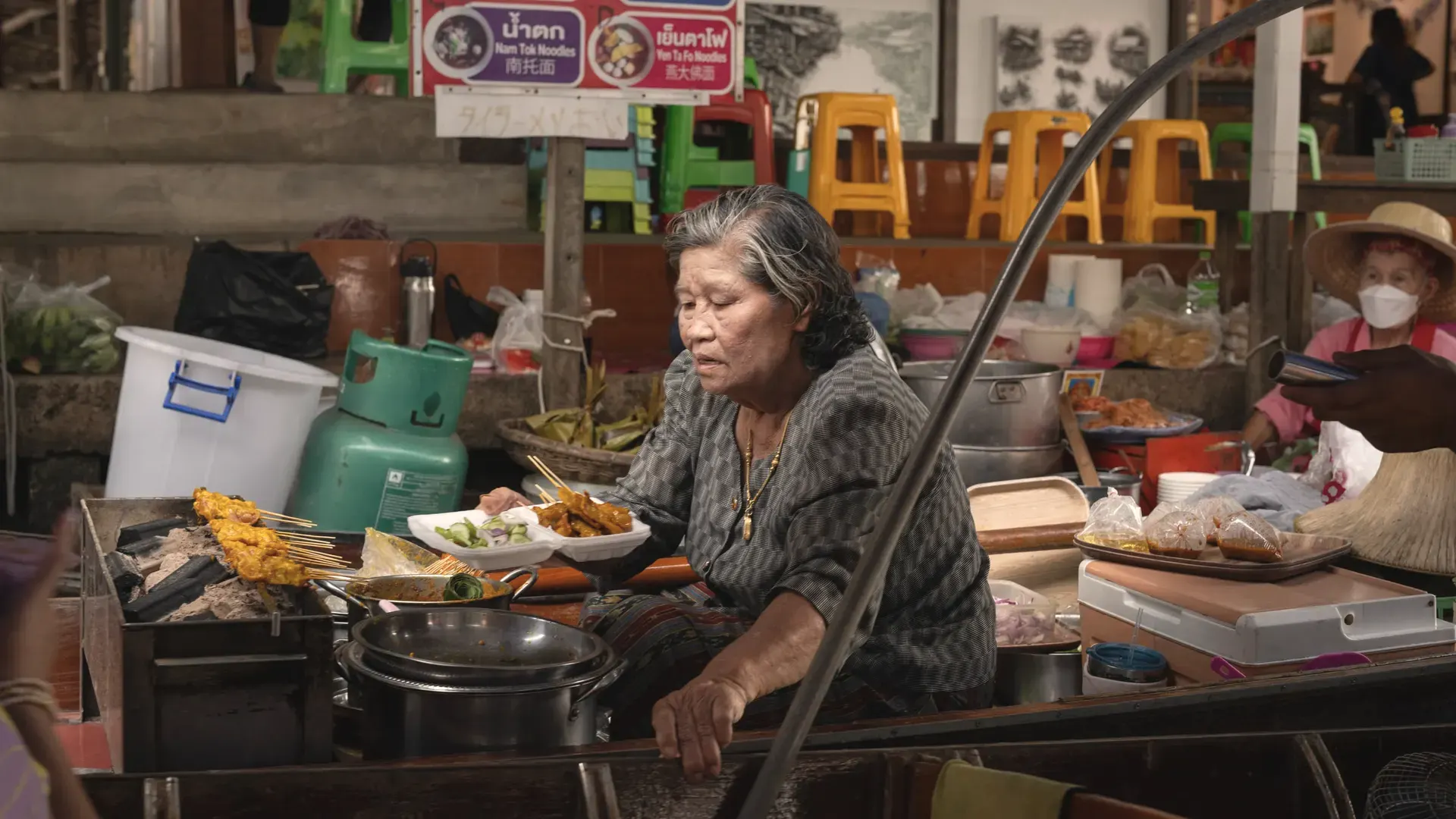
Khon Kaen runs cheaper than Bangkok, Phuket or Chiang Mai for food overall. Local markets and Isaan specialty stalls, som tam, larb and sticky rice, keep the everyday bill low, while the food courts at Central Plaza and Fairy Plaza offer a convenient mid-range option and Western dining is thinner and pricier than in bigger university towns. For the weekly shop, the Tops supermarket inside Central Khon Kaen is the most central full grocery, while Big C, Lotus's and Makro cover large-format and bulk buying, the Khon Kaen shopping guide lists the branches.
Transport
Khon Kaen has no BTS, MRT or urban rail, and one scheduled city bus route rather than a network, a car or scooter is close to essential for most residents, though the Bueng Kaen Nakhon and Central Plaza area is walkable on foot. Songthaews and motorbike taxis cover short local trips, Grab is reliable in the city center and around KKU, Khon Kaen International Airport (KKC) gives a roughly one-hour flight to Bangkok, and the railway station, the largest in the northeast, puts Bangkok, Udon Thani, Nong Khai and Vientiane on the intercity network. The nearest Laos border crossing runs via Nong Khai, a little over two hours away by road through Udon Thani, or straight through on the daily international train.
Mode
Typical cost
Songthaew (shared truck) hop
THB 15–30
Motorbike taxi, short ride
THB 25–50
Long-term scooter rental, per month
THB 2,000–3,000
Scooter petrol, per month
THB 250–500
Grab (Khon Kaen city & KKU area)
THB 50–150
Long-term small-car rental, per month
THB 10,000–18,000
Flight, Khon Kaen (KKC) → Bangkok, ~1 hr
THB 900–2,200
Bus/van to Nong Khai for the Laos border crossing, ~2 hrs
THB 150–300
Taxi / private transfer to Khon Kaen Airport (KKC)
THB 150–300
Khon Kaen City Bus Route 24, Bus Terminal 3 to the airport (published flat fare)
THB 15
Utilities, internet & lifestyle
Item
Typical cost
Electricity, 1-bed condo running AC
THB 1,200–2,800
PEA household tariff, Sept–Dec 2026 period (ERC average)
≈ THB 3.95 / unit
Landlord-billed electricity, common in apartments near KKU
THB 6–8 / unit
Water
THB 80–200
Home fiber internet, 300–1000 Mbps
THB 450–700
Mobile plan with generous data
THB 200–450
Condo common-area fee (owners), per sqm
THB 25–50 / sqm
Gym / fitness membership
THB 600–1,500
Co-working hot desk, monthly
THB 2,000–3,500
Electricity is the variable to watch, heavy AC use during the hot season (roughly March–May) means a comfortable one-bed condo often runs THB 1,200–2,800 a month. Khon Kaen is on the Provincial Electricity Authority (PEA) grid, and the Energy Regulatory Commission set the average household tariff for September–December 2026 at about THB 3.95 per unit; September bills came in at about THB 3.89, with the first 200 units capped at THB 3 on household meters (The Nation, 12 August 2026). The bigger swing is who bills you: a condo or house on its own PEA meter pays the official tariff, while many privately let apartments and rooms around KKU and Central Khon Kaen re-bill tenants at a flat THB 6–8 per unit, which can add 30–80% to the bill, get the per-unit rate in writing before you sign. Water in the built-up city comes from Provincial Waterworks Authority (PWA) mains and is a small line item. The Khon Kaen utilities guide covers connection and bill payment. Fiber internet is fast and widely available across the city center and university corridor; co-working space is thinner than in bigger cities but growing alongside Khon Kaen's "smart city" tech push.
Healthcare, insurance & schools
Khon Kaen has the strongest healthcare infrastructure in Isaan, anchored by Srinagarind Hospital, Khon Kaen University's teaching hospital and the region's leading tertiary referral center, alongside Khon Kaen Hospital (public) and Khon Kaen Ram Hospital (private) for everyday and urgent care with English-speaking staff; a private GP visit typically runs THB 600–1,200. Comprehensive private health insurance is worth arranging before you move, particularly for retirement-visa requirements, and typically costs THB 30,000–90,000 a year for an individual, more for a family, depending on age and cover level. For families, schooling is the biggest swing factor in any Khon Kaen budget, and the choice is far thinner than a list of school names suggests. Of the city's four international and bilingual schools, only one teaches a child past the age of twelve, and it is the Thai bilingual school, Khon Kaen Vithes Suksa (KKVS), which leads to the Thai Mathayom 6 certificate plus Cambridge IGCSE subjects; no A Level, IB Diploma or US high-school diploma is taught anywhere in the city. BAANLYY deliberately publishes no per-school fee figures because they change every year, ask each school for its current fee schedule, and see the Khon Kaen schools guide for what each one actually teaches. Families with teenagers should factor in the possibility of boarding or moving to Bangkok for the final school years.
Budgets
Three realistic monthly budgets
Lean, local lifestyle
THB 20,000–32,000$590–950 / month
Suburban or budget-local room or studio, eats almost entirely Thai/Isaan food, gets around by scooter or songthaew.
Studio or 1-bed in a budget-local area: THB 3,500–7,000
Food, mostly local Thai & Isaan: THB 5,000–8,000
Scooter, petrol + occasional songthaew: THB 2,500–3,500
Utilities, internet, mobile: THB 1,800–3,000
Leisure & incidentals: THB 2,000–4,000
Health insurance (amortised): THB 3,000–5,000
Comfortable mid-expat single or couple
THB 35,000–55,000$1,040–1,630 / month
1-bed near Central Plaza, the KKU/Srinagarind corridor or the Bueng Kaen Nakhon lakefront, a mix of Thai and Western dining, a scooter or occasional Grab.
1-bed near the center, lakefront or KKU/Srinagarind: THB 7,000–13,000
Scooter + regular Grab, or a small car: THB 4,000–10,000
Utilities, internet, mobile: THB 2,500–4,000
Gym, co-working, leisure: THB 4,000–7,000
Health insurance (amortised): THB 4,000–7,000
Premium or family lifestyle
THB 50,000–90,000 + school fees$1,480–2,670 + fees / month
Larger condo, house or villa near the university/hospital corridor or lakefront, a car and family health cover, before school fees, which are the biggest swing factor and vary by school and year group.
Larger condo, house or villa: THB 15,000–30,000+
Food & groceries for a family: THB 15,000–24,000
Car (running costs, fuel, insurance): THB 6,000–12,000
Utilities, internet, mobiles: THB 3,500–6,000
School fees, ask each school for its current schedule (see the schools guide)
Family health insurance (amortised): THB 8,000–15,000
Ranges are guides, not quotes; your number depends most on area, condo or house and (for families) school choice.
FAQ
Khon Kaen cost-of-living questions
How much does it cost to live in Khon Kaen per month?
As a planning range: a lean, local lifestyle runs roughly THB 20,000–32,000 (about USD 590–950) a month, a comfortable mid-expat single or couple lifestyle runs THB 35,000–55,000, and a premium or family lifestyle with a car runs roughly THB 50,000–90,000 before school fees, which vary by school and are best confirmed directly with each one. Khon Kaen is one of the more affordable Thai cities to live well in, similar to Udon Thani and comfortably under Chiang Mai, Phuket or Bangkok.
Is Khon Kaen cheaper than Udon Thani or Chiang Mai?
Khon Kaen runs roughly in line with Udon Thani and clearly cheaper than Chiang Mai, Phuket or Bangkok. Rent is the biggest lever: a furnished one-bedroom in a budget-local area starts around THB 5,000, while a unit near Central Plaza, the Bueng Kaen Nakhon lakefront or the Khon Kaen University (KKU) / Srinagarind Hospital corridor typically runs THB 7,000–13,000, still well under equivalent Chiang Mai or Phuket pricing.
How much is rent near Khon Kaen University or Central Plaza?
A furnished one-bedroom near the KKU/Srinagarind corridor typically runs THB 6,500–9,500 a month, and one near Central Plaza and Fairy Plaza in the city center runs THB 7,000–10,000. The Bueng Kaen Nakhon lakefront carries a small premium at roughly THB 8,000–12,000, while suburban Khon Kaen outside the center is the cheapest option at THB 5,000–7,000.
Do I need a car in Khon Kaen?
Khon Kaen has no BTS, MRT or urban rail, and only one scheduled city bus route, so most long-stayers rely on a car, motorbike, songthaew (shared truck) or Grab to get around, though the Bueng Kaen Nakhon and Central Plaza area is walkable on foot. The railway station carries intercity trains to Bangkok, Udon Thani, Nong Khai and Vientiane, not journeys across town. Khon Kaen International Airport (KKC) connects to Bangkok in about an hour, and the nearest Laos border crossing is via Nong Khai, a little over two hours away by road through Udon Thani.
What does food cost in Khon Kaen?
A local Thai or Isaan meal, som tam, larb, sticky rice, at a market stall or local restaurant runs THB 35–120, a casual restaurant THB 70–160, and a mid-range dinner for two THB 350–800. Central Plaza and Fairy Plaza's food courts are a convenient mid-range option at THB 60–150 per meal, while monthly groceries for a couple mixing local and imported goods run roughly THB 6,000–11,000.
Why is my Khon Kaen electricity bill higher than the PEA rate?
Usually because the landlord re-bills it. The Provincial Electricity Authority's average household tariff for September–December 2026 is about THB 3.95 per unit, but many privately let apartments and rooms around Khon Kaen University and Central Khon Kaen charge tenants a flat THB 6–8 per unit instead, which can add 30–80% to the bill. A condo or house with its own PEA meter pays the official tariff, so ask for the per-unit rate in writing before signing a lease.
How much should I budget for school fees in Khon Kaen?
BAANLYY does not publish per-school fee figures for Khon Kaen, because they change every year and published numbers for the city have been badly wrong before, so ask each school for its current fee schedule. Before comparing prices, check what each school actually teaches: of the city's four international and bilingual schools, only Khon Kaen Vithes Suksa Bilingual School teaches children past the age of twelve, and no A Level, IB Diploma or US high-school diploma is taught anywhere in Khon Kaen.
Primary and official sources are cited above. Government rules, fees and procedures in Thailand change over time and vary by office; always confirm current requirements with the relevant authority before relying on them. BAANLYY never takes paid placement in editorial content.
Match your monthly number to the right Khon Kaen area, the city center, the KKU/Srinagarind corridor, the lakefront or the suburbs, then run the rental maths before you commit.
Hero photo by Miguel Cuenca on Pexels. General information and indicative pricing, not financial advice; confirm current details with official sources or a qualified professional.